(631)-271-3737,
QUEENS
(718)-751-0226
(516)-307-0262,
BROOKLYN
(347)-508-9316,
BOHEMIA
(631)-223-4502
(631)-271-3737,
QUEENS
(718)-751-0226
(516)-307-0262,
BROOKLYN
(347)-508-9316,
BOHEMIA
(631)-223-4502
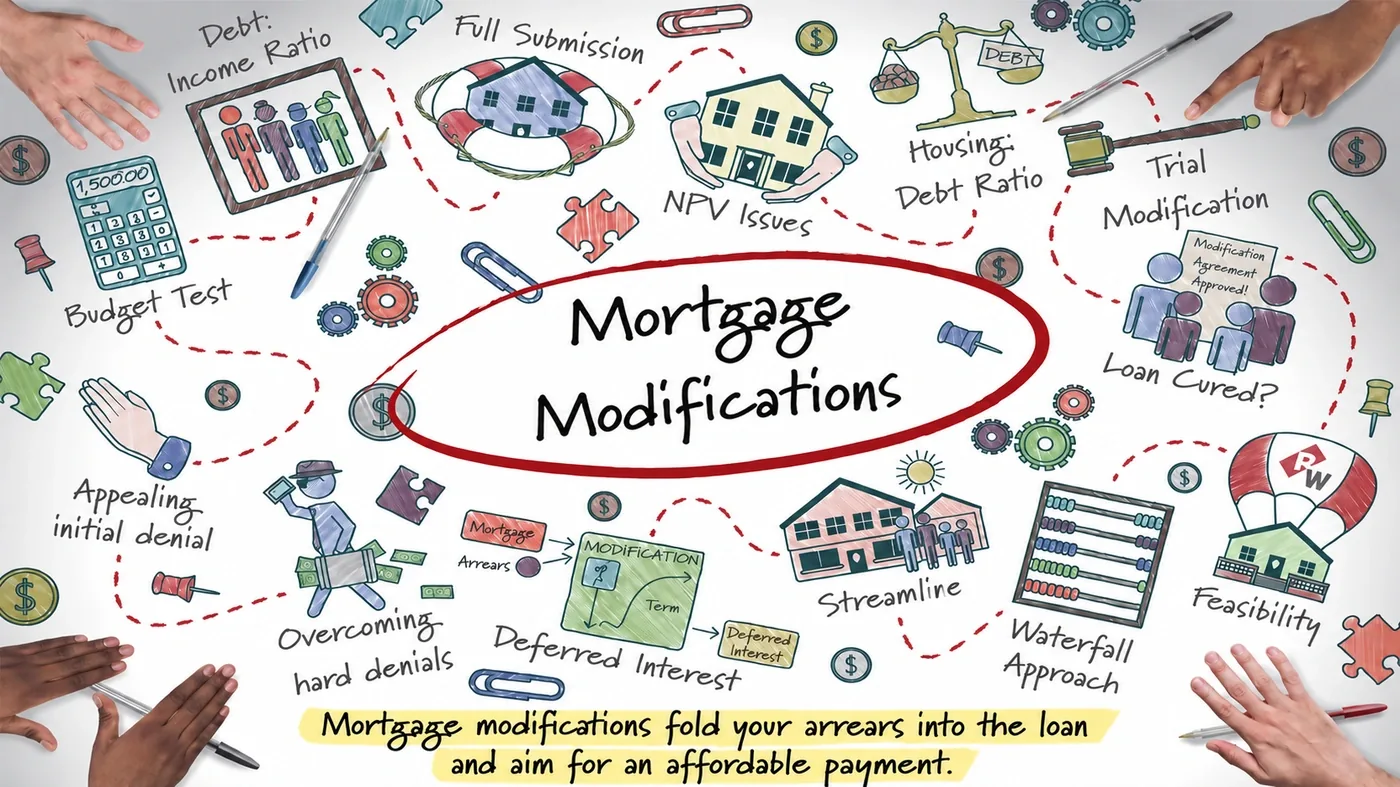
We obtain mortgage loan modifications — and other “retention options” that let you keep your home — by absorbing your arrears into the loan and negotiating an affordable new monthly payment.


Mortgage modifications are the most frequently pursued means of saving a home in serious mortgage arrears from foreclosure — and a strong concentration of our office.
Because most individuals undergoing serious hardships with their mortgages are seeking “retention options” — options that resolve their mortgage issues while letting them keep, rather than lose, their homes — mortgage modification specifically, and other potential retention options, are the goals of most homeowners in foreclosure. A modification is intended to prevent foreclosure by absorbing your mortgage arrears into the remaining principal balance, thereby eliminating the amount in default by making the principal of the loan larger.
While the restructured loan is larger, the goal is to allow for an affordable new monthly payment by: reducing the interest rate, if possible; extending the duration of the loan, if possible; deferring, in some cases, part of the interest arrears to the end of the loan; and/or, in some cases, forgiving part of the arrears. The aim is to cure the default and, at the same time, secure affordable payments that avoid a future default.

For homeowners seeking to save a distressed home or other real estate from foreclosure, there are several retention options we assess — and a modification is only one of them.
For homeowners seeking “retention options” — options to save their distressed home, or other real estate, from foreclosure — there are several paths we discuss in this section and typically assess for homeowners seeking to save their properties. Only after assessing these retention options, if we determine that a homeowner is incapable of or uninterested in saving their property, do we assess “non-retention” options, or how to negotiate with the lender to best leverage an eventual surrender of the property. Non-retention options are explored in more detail in our separate Debt Negotiations & Settlements section. The retention options for a property — especially mortgage modification — are enumerated below.
Before any surrender is considered, these are the options we assess for a homeowner determined to keep the property.
Absorbs mortgage arrears into the loan principal and creates an affordable monthly payment through favorable new terms — a lower interest rate, a longer term, and the deferment and/or forgiveness of arrears. It can be sought by direct application to the lender, during a foreclosure litigation as part of settlement conferences, or during a bankruptcy case as a “loss mitigation” effort.
Chapter 13 (for the typical homeowner) and Chapter 11 (for higher debt amounts) restructure mortgage arrears under a court-approved plan — either a traditional “catch-up” plan that cures arrears over five years, or a “loss mitigation” plan that pursues a modification with the added protection of the automatic stay and Bankruptcy Court oversight.
A voluntary sale to a friendly party may let the homeowner rent the home afterward, or buy it back at an agreed price when finances recover. Where the mortgage balance exceeds fair market value, a short sale asks the lender to reduce the payoff to a realistic amount so the property can sell.
The “payoff” is payment in full of the mortgage balance plus arrears — taxes, interest, attorney fees and costs. A short payoff is a lower amount accepted in full satisfaction. Both resolve the matter simply, but are rarely used since most distressed homeowners lack ready access to funding.
Payment of only the amount in default — past-due installments including principal, interest and escrow for insurance and real estate taxes — that, if cured, resolves the issue giving rise to the foreclosure. A “short reinstatement” negotiates to reinstate the loan for less than the full past-due amount.
In a refinance, the borrower — alone or with friendly parties — obtains a new loan to replace the older one and become current. In a forbearance, the lender agrees not to foreclose on several months’ arrears, after which the borrower cures the arrears over time while resuming regular monthly payments.

Since 1988 we’ve guided New Yorkers out of debt and back to the lives they want to live.
Although the negotiations can be prolonged and difficult, mortgage modifications can make your mortgage more affordable — if you can show both hardship and the financial strength to stay current afterward.
Mortgage modification agreements are currently a strong option for many of our clients undergoing financial difficulty due to mortgage arrears. In the current economic climate, many clients have fallen behind on their regular monthly payments. To qualify, a client needs to show “hardship,” but at the same time must show financial strength sufficient to stay current with the mortgage once a modification is obtained.
Mortgage modifications have been especially sought after — and increasingly obtainable — since the recession of 2008–2014, which was started by overly aggressive mortgage lending and borrowing. Its effects are still with us in the form of many unresolved foreclosures and mortgage problems. The economy improved greatly, then went into a severe downturn due to the COVID-19 lockdowns, furloughs and layoffs, leaving many homeowners in arrears and in or threatened by foreclosure — while also creating pressure on lenders and governments to find better solutions, a large part of which is the potential to seek a modification or other negotiated solution with one’s lender.
The modification is currently the most frequently used and successful option for homeowners seeking to cure arrears, resolve foreclosure litigation, and save their homes.
The federal HAMP program reshaped how modifications work — and even after it expired, it inspired the private, in-house modification programs nearly every major lender offers today.
A voluntary federal program lets “at-risk” homeowners apply to renegotiate their loan — lowering payments by cutting interest and extending the term.
Rules relax for many loans; borrowers with equity loans and second mortgages are no longer disqualified, and owner-occupancy and first-lien limits soften.
Private “in-house” modification programs — more within lenders’ control — become the only modification options available.
Under legislation passed in February 2009, the federal government enacted a voluntary program to encourage lenders to modify mortgages for “at-risk homeowners.” The Home Affordable Modification Program (“HAMP”) allowed homeowners to apply to their lender to renegotiate the terms of their loan. The monthly payment could be lowered by reducing interest and extending the loan term; lenders were not required to reduce principal. A part of the original proposals — which did not pass the Senate — would have let bankruptcy judges require a modification if a lender refused reasonable proposals. At present, loan modifications remain strictly voluntary, and a lender can reject, deny, or fail to respond to a borrower.
Under HAMP, the homeowner needed to be “at risk” with serious hardship — loss of income, increase in expenses, or “payment shock” from significant payment increases. Lenders would lower payments exceeding 31% of gross income by dropping interest rates to as low as 2% and, if necessary, extending the loan term up to 40 years, receiving a federal incentive for modifying a loan. The HAMP program expired on December 31, 2016, but it inspired lenders to expand their similar “in-house” programs, which were more within their control and less subject to government regulation.
Under both HAMP and the “in-house” programs, the arrears on a mortgage are combined with the remaining principal balance, with the interest reduced and the loan term extended — effectively creating a larger loan on which the monthly payments are smaller. Because HAMP has been largely replaced by non-HAMP private bank modifications that almost every major lending institution offers, borrowers no longer need to be screened first for HAMP; the “in-house” options offered by the particular lender are now the only modification options available.
While HAMP provided government oversight and financial subsidies, and started at low interest rates of 2–3% with stepped-up interest over time, it was mired in more regulation, paperwork, and layers of administration. Present non-HAMP private “in-house” modifications are more direct and quicker in some instances, but lack the federal oversight that helped in some cases. As HAMP ended, the bankruptcy courts saw a surge of Chapter 13 and 11 cases featuring “loss mitigation” plans central to their reorganizations — providing judicial oversight to the modification process. With the COVID-19 downturn, more homeowners are expected to fall behind, and new government and private efforts may be needed to address a potential new foreclosure crisis.
Trusted foreclosure and modification representation across Long Island, Queens & Brooklyn.
Schedule a Free Consultation
Your arrears cured, your payment lowered — and your home kept.
Schedule a Free Consultation
Every situation is different. We find the path that protects what matters most to you.
Free ConsultationBecause many lenders and their attorneys are not sufficiently responsive to negotiated offers, obtaining a modification takes careful strategy, persistence, and a broader approach that is never dependent on any single solution.
Many homeowners in Suffolk and Nassau Counties, Long Island experiencing financial difficulty with their mortgage payments are retaining modification attorneys such as the Law Office of Ronald D. Weiss, P.C. to handle what has become a complex and often difficult negotiation. While the ultimate goal is very worthwhile, such negotiations can be difficult and uncertain because many mortgage holders and their attorneys are not sufficiently responsive to negotiated offers — requiring a significant and persistent effort involving careful strategy and planning. Because we are always considering more than one foreclosure solution, we are not solely dependent on modifications and use a broader approach to help our clients. The client should maximize their negotiating advantages by having our office represent them for the following reasons.
We leverage our ability and experience to otherwise defend and protect you in a foreclosure in order to obtain an agreement. We have more influence with your lender and their attorneys, and we know how to approach them and how to structure an agreement — so we are never solely dependent on a modification being approved.
Compare us to others. Although our credentials far exceed those of our competition in this area, we charge less — a genuine advantage for homeowners who are already under financial strain.
If we cannot obtain an agreement acceptable to you, such an agreement was probably not going to be forthcoming from your mortgage holder. A successful modification usually involves a concerted, persistent campaign urging the lender — through an application, letters, calls, and supportive documents — to modify the loan.
Unlike the national services soliciting this work on a massive scale and impersonally dealing with files that require individualized care, we are local and can respond to your specific needs.
We are very skilled at what we do, but we do not pretend that we will always succeed. If we do not reach an acceptable agreement, we will be able to represent you and advise you as to other foreclosure solutions — because we always consider more than one option from the outset.
Room to breathe again — your home kept, your payment back within reach.
Talk to an Attorney
The right filing can eliminate or reduce overwhelming debt — giving your family room to breathe, save, and move forward with confidence.
Our firm has negotiated thousands of agreements — modifications, forbearances, payment plans, short sales, deeds in lieu, and other settlements — that resolved the foreclosure process and let our clients save their homes.
The Law Firm of Ronald D. Weiss, P.C. has negotiated thousands of agreements giving its clients the opportunity to resolve their mortgage arrears. We have negotiated many mortgage modification agreements, forbearance agreements, payment plans, short sales, deed-in-lieu agreements, and other settlements, which have resolved the foreclosure process and allowed our clients to save their homes. Allowing us to represent and negotiate terms for you ensures a prompt resolution of the foreclosure process. It is critical to have the settlement terms agreed to in a legally binding written stipulation of settlement, while making sure that your rights are protected at all times.
Because of our firm’s long experience with mortgage loan modifications, our talented staff will enhance your ability to obtain approval. If a modification is not possible, we will assess and pursue other retention options — and if none of those are possible or wanted, we can advise you on the “non-retention” options for borrowers not seeking to keep their distressed property.
Please contact us for a free consultation to discuss modification and negotiation options in greater detail. We can discuss and advise you about a mortgage modification and other retention options, and whether they fit your particular circumstances.

Seeking a modification and/or other retention option is a complex, often difficult negotiation — the kind of process our office is built to handle for homeowners across Nassau and Suffolk.
Successful modifications and/or other retention options usually involve the client retaining a qualified professional working on their behalf, and a concerted, persistent campaign to urge the lender — through an application, letters, calls, and supportive documents — to modify a particular mortgage loan. From our office in Melville, Long Island, we represent homeowners in Suffolk and Nassau Counties and across the New York City area in exactly that effort.
If you are overwhelmed with a problematic mortgage, the Law Firm of Ronald D. Weiss, P.C. can represent you in seeking a modification and/or other retention options. Because we always consider more than one foreclosure solution, we are never solely dependent on a single outcome — and if a modification cannot be obtained, we can pursue other retention options or advise you on your alternatives.

Our consultations are free — the advice may be invaluable.
How our attorneys help you save your home and resolve mortgage debt.
Our attorneys have represented Long Island and New York City clients since 1988. Schedule your free, confidential consultation today.