(631)-271-3737,
QUEENS
(718)-751-0226
(516)-307-0262,
BROOKLYN
(347)-508-9316,
BOHEMIA
(631)-223-4502
(631)-271-3737,
QUEENS
(718)-751-0226
(516)-307-0262,
BROOKLYN
(347)-508-9316,
BOHEMIA
(631)-223-4502
Using the power of a bankruptcy plan to stop foreclosure and keep your home — a court-supervised path to cure your mortgage arrears over time.


When a homeowner falls behind on a mortgage, the goal is often not to walk away but to keep the property — and a reorganization plan is one of the most powerful ways to do exactly that.
A bankruptcy reorganization plan — filed under either Chapter 13 or Chapter 11 of the Bankruptcy Code — can be one of the most powerful “retention options” available for keeping your home. Unlike an out-of-court modification, which depends on the lender’s voluntary cooperation, a reorganization plan works through the federal bankruptcy court and carries the force of law behind it.
The Law Office of Ronald D. Weiss, P.C. has represented Long Island homeowners and small businesses in Chapter 13 and Chapter 11 cases for more than three decades. This page explains why a bankruptcy plan can be used as a retention option, how Chapters 13 and 11 treat a mortgage in default, the advantages and disadvantages to weigh, and when a reorganization plan is the right tool for your situation.

A “retention option” is any strategy whose purpose is to help you keep your home — and a reorganization plan is a retention option of a stronger kind, because it does not require the lender’s permission to move forward.
A “retention option” is any strategy whose purpose is to help you retain — keep — an asset such as your home, rather than surrender it. Mortgage modifications, forbearance agreements, and reinstatements are all retention options that depend on negotiating with your lender. A bankruptcy reorganization plan is a retention option of a different and stronger kind, because it does not require the lender’s permission to move forward.
Because the plan is confirmed and enforced by the bankruptcy court, it provides a level of certainty and protection that a purely voluntary negotiation cannot. As long as you comply with the plan, the lender cannot restart the foreclosure, and you have a clear, legally binding path back to being current on your loan.
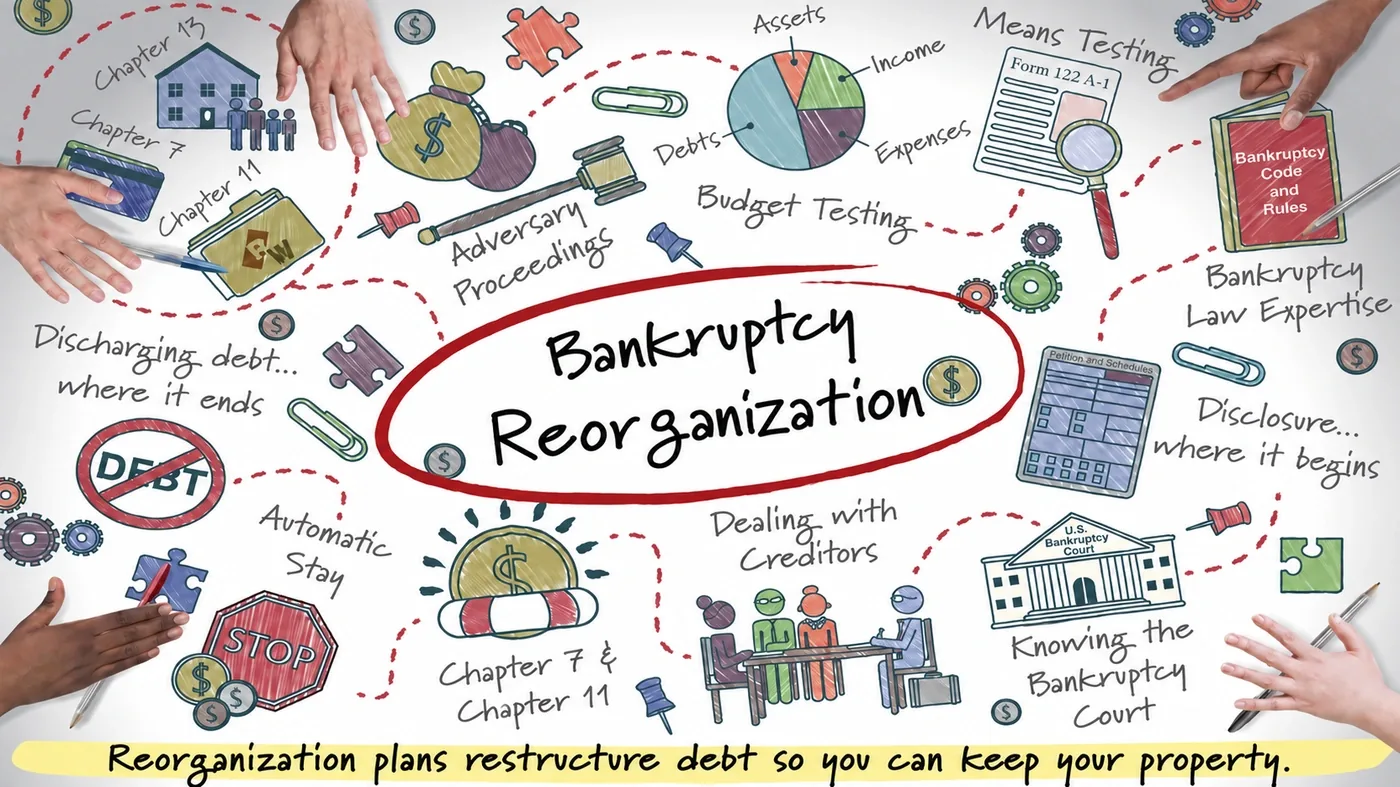
The moment a Chapter 13 or Chapter 11 case is filed, the “automatic stay” takes effect and immediately halts a foreclosure sale and most other collection activity — giving you the time and leverage to reorganize.

The right filing can eliminate or reduce overwhelming debt — giving your family room to breathe, save, and move forward with confidence.
Free ConsultationBoth Chapter 13 and Chapter 11 let a homeowner deal with mortgage arrears inside a reorganization plan, but they serve different situations. In both chapters, the arrears are addressed through a plan rather than in a single lump sum.
Chapter 13 is designed for individuals with regular income and debts within the Chapter 13 limits, and is the most common choice for a homeowner trying to save a residence. Chapter 11 is available when the debts are too large for Chapter 13, or when the property is held by a business or investor, and it can accommodate larger and more complex cases. In both chapters, the same core idea applies: the arrears are addressed through a plan rather than in a single lump sum. There are three basic ways a plan can address the mortgage.
In a traditional or “catch-up” plan, you cure the mortgage default by paying the accumulated arrears in equal installments over the life of the plan, while simultaneously resuming your regular monthly mortgage payments going forward. At the end of the plan you are fully current, and the original loan continues on its original terms. This is the classic use of Chapter 13 to reinstate a mortgage and defeat a foreclosure without needing the lender to agree to any new terms.
A loss-mitigation plan combines the protection of the bankruptcy case with a negotiated modification of the loan itself. Many bankruptcy courts have a formal loss-mitigation program that brings you and the lender to the table, under court supervision, to pursue a modification of the interest rate, term, or principal while the case is pending. If a modification is approved, the plan is built around the new, modified payment — often a better long-term outcome than simply catching up on the old terms when the original payment was never affordable to begin with.
Not every case ends in keeping the property. When retention is not realistic, a reorganization plan can also provide an orderly framework to sell the home — or to complete a short sale with the lender’s cooperation — on your timetable rather than at a forced foreclosure auction. This preserves equity where it exists, can reduce or resolve a potential deficiency, and lets you transition on your own terms while the automatic stay keeps the foreclosure at bay.
Trusted debt-relief representation across Long Island, Queens & Brooklyn.
Schedule a Free Consultation
Our focus is simple: keep good people in the homes and lives they’ve worked hard to build.
Whether a reorganization plan is right for you depends entirely on the facts of your situation. Here are the benefits to weigh against the trade-offs before choosing this retention option.
A bankruptcy filing appears on your credit report and requires a formal, disclosed court process. You must have sufficient regular income to fund both the plan payment and your ongoing mortgage payment. Chapter 13 has debt limits, and larger cases may require the greater complexity and cost of Chapter 11. The plan also requires ongoing discipline — missed payments can lead to a motion for relief from the stay or dismissal of the case.
Whether the advantages outweigh the disadvantages depends entirely on the facts of your situation. Our office reviews your income, your arrears, the equity in your home, and your goals before recommending a reorganization plan over other retention options.
Your home protected, your debts reorganized — and your footing restored.
Schedule a Free Consultation
A reorganization plan is often the strongest choice when foreclosure is imminent, when your lender has refused an affordable modification, or when you have arrears but a stable, provable income.
A bankruptcy reorganization plan is often the strongest choice when a foreclosure sale is imminent and there is no time to complete a voluntary modification, when your lender has refused to offer an affordable modification, or when you have substantial arrears but a stable, provable income that can support a catch-up or modified payment. It is also the right tool when you need to address the mortgage and other debts together, or when you want the certainty of a court-enforced result rather than an informal promise.
By contrast, a straightforward out-of-court mortgage modification may be preferable when there is no immediate foreclosure pressure and the lender is willing to negotiate reasonable terms. Because Chapter 13, Chapter 11, and modification negotiations each have their place, the decision should be made with an attorney who can compare all of your retention options side by side and match the strategy to your circumstances.
Room to breathe again — your home kept, your debts back under control.
Talk to an Attorney
When the pressure lifts, everything feels lighter. We help New York families get there — and stay there.
We can evaluate a reorganization plan alongside every other option and recommend the approach that best protects your home and your finances.
The Law Office of Ronald D. Weiss, P.C. concentrates in bankruptcy, foreclosure defense, mortgage modification, and debt negotiation, which means we can evaluate a reorganization plan alongside every other option and recommend the approach that best protects your home and your finances. As a local Long Island firm, our files are always open to our clients, and we handle the litigation, the loss-mitigation negotiations, and the plan itself in-house.
If you are facing foreclosure or falling behind on your mortgage, contact us for a free consultation to discuss whether a Chapter 13 or Chapter 11 reorganization plan is the right retention option for you.

Our consultations are free — the advice may be invaluable.
How our attorneys can help at every stage of your case.
Our attorneys have represented Long Island and New York City clients since 1988. Schedule your free, confidential consultation today.