(631)-271-3737,
QUEENS
(718)-751-0226
(516)-307-0262,
BROOKLYN
(347)-508-9316,
BOHEMIA
(631)-223-4502
(631)-271-3737,
QUEENS
(718)-751-0226
(516)-307-0262,
BROOKLYN
(347)-508-9316,
BOHEMIA
(631)-223-4502
A bankruptcy appeal can potentially set aside and / or improve an unfair or erroneous decision that may be critical to a debtor’s bankruptcy case — a powerful tool when handled by a firm comfortable in the appellate environment.


A bankruptcy appeal can potentially set aside and / or improve an unfair or erroneous decision that may be critical to a debtor’s bankruptcy case.
An appeal from the Bankruptcy Court is substantively and procedurally challenging and requires a high level of knowledge, expertise and skills in the bankruptcy area and in appellate advocacy. Therefore, a bankruptcy appeal can potentially be a powerful tool in a bankruptcy matter, because if it is handled correctly, it gives advantages to law firms, like ours, which are comfortable in advocating in a more challenging appellate environment that focuses on bankruptcy law and procedure.

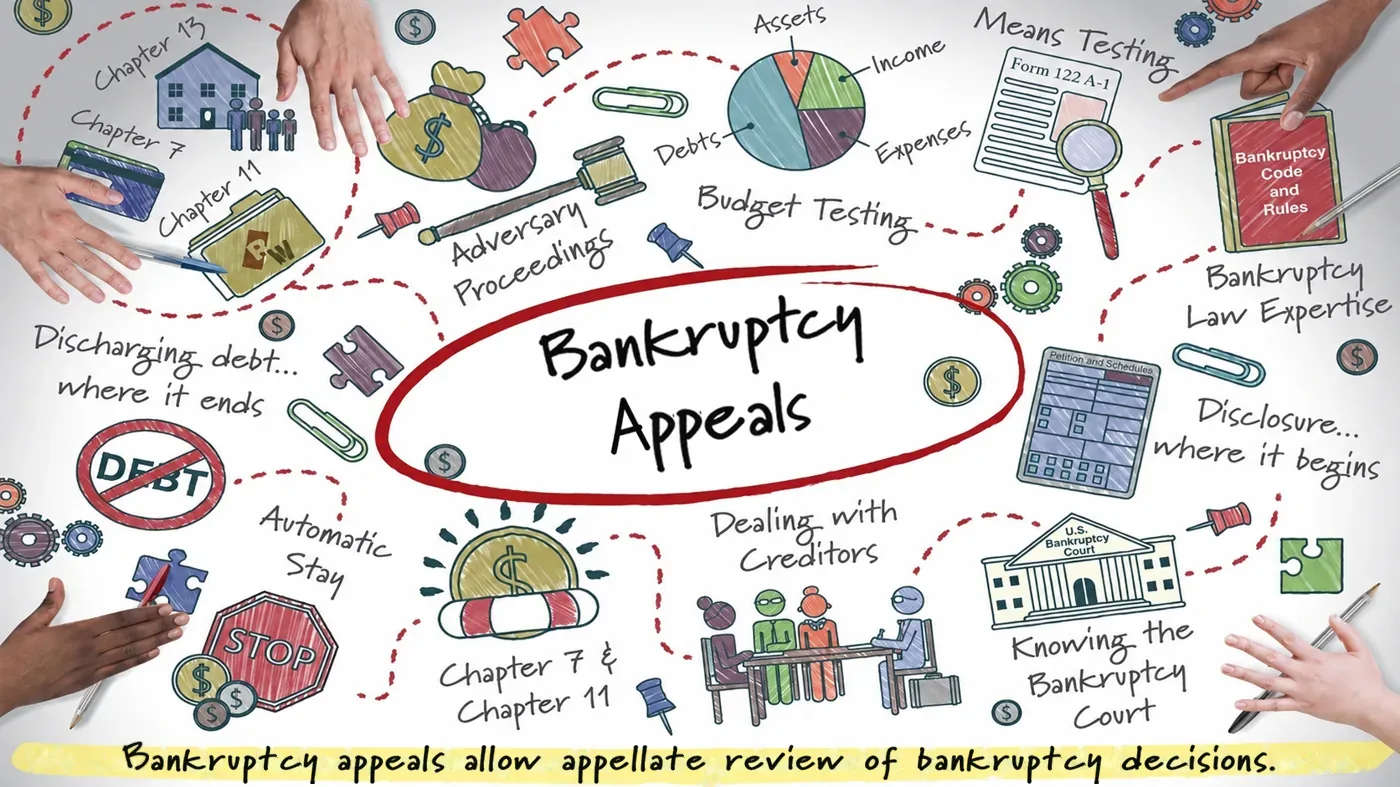
Bankruptcy appeals allow appellate review for a debtor who believes a Bankruptcy Judge was unfair and / or erred in deciding their case — usually on a decision critical to the outcome.
Bankruptcy appeals allow appellate review to a debtor believing that a Bankruptcy Judge was unfair and / or had erred in deciding their case. Usually the decision appealed from is critical to the bankruptcy case and has facts that are complex or unclear and may have been misconstrued by the Bankruptcy Judge, and / or bankruptcy statutory and case law is not settled as to the relevant issues decided by the Bankruptcy Court and as a result has divided cases interpreting the law differently. This situation presents a worthwhile opportunity for an appeal where we can either reverse / improve an unfavorable bankruptcy court decision and / or enhance our position in terms of time, leverage and / or momentum.

The right filing can eliminate or reduce overwhelming debt — giving your family room to breathe, save, and move forward with confidence.
The Bankruptcy Court is a specialized federal court — more demanding in procedure, law and advocacy, with sharper deadlines than the broader state-court system.
Bankruptcy appeals are different than appeals from decisions of the New York State Supreme Court, in that the Bankruptcy Court, as a specialized federal court, is generally much more demanding as to the familiarity with procedure, the law and advocacy skills, than the NYS Supreme Court, which is a court of general and broader jurisdiction. The appellate briefs that accompany a bankruptcy appeal tend to generally show a higher intellectual level of argument, in that bankruptcy appeals involve not only interpretation of the Bankruptcy Code and Rules, but sometimes the Federal Rules of Evidence, the Federal Rules of Civil Procedure, the Local Bankruptcy Rules for that District and even applicable state law.
Bankruptcy law is a highly developed but still narrow and specialized area of law which is dynamic and constantly evolving based on legislative changes and changes in our society and economic realities. Therefore, there are many areas of bankruptcy law that are unsettled which could be ripe for an appeal under the right set of circumstances. The procedural rules in the bankruptcy area are also more demanding in having sharper and less lenient deadlines.
A bankruptcy appeal requires three building blocks — a notice of appeal to initiate, a record on appeal, and an appeal brief or memorandum of law — on a brisk, court-supervised schedule.
A short statement naming the order being appealed and the parties and counsel, filed and served to initiate the appeal.
The appellant designates the items for the record and the issues; the Clerk transmits the documents to the higher court.
The legal memorandum arguing why the Bankruptcy Court’s decision was in error — the heart of the appeal.
The appellee supplements the record and files opposition on similar deadlines; the District Court then decides.
A bankruptcy appeal requires: 1) the filing of a notice of appeal to initiate, 2) a record on appeal, and 3) an appeal brief or memorandum of law. A Notice of Appeal from the Bankruptcy Court’s final judgment (in a bankruptcy case, contested motion and / or adversary proceeding) must be filed and served on the appellee within 14 days of when an appealable order is entered on the docket. A Notice of Appeal is a short statement which states the order, decision and / or judgment which is being appealed and gives the names of the appellant and the appellee and their respective counsel.
Within 14 days after the Notice of Appeal becomes effective, the appellant must file and serve the Designation of the items to be included in the record on appeal and a statement of the issues to be presented on appeal. When the record is complete, the Clerk of the Bankruptcy Court then transmits to the higher court all of the documents filed in connection with the appeal. Here, the advantage of an appeal in Bankruptcy Court is that the clerk’s office is indirectly able to assist in setting aside the previously filed documents relevant to the appeal. This makes the bankruptcy appeals process comparatively easier than an appeal from an order issued by the NYS Supreme Court, since an appeal of a state court order requires a printed record of all documents relevant to the appeal.
Within 30 days after the docketing of the notice that the record has been transmitted or is available electronically, the appellant must serve and file a legal brief supporting their appeal. The memorandum on appeal is the debtor’s legal argument as to why the decision of the bankruptcy court was in error. The timing of the brief is much shorter than with appeals from the NYS Supreme Court, which allow six (6) months to file the appellate memorandum. The quicker deadline makes a bankruptcy appeal more relevant and powerful in that the parties and the Bankruptcy Judge on the case are all aware that a decision from the United States District Court is forthcoming and may critically alter the direction of the bankruptcy matter. The appeal generally proceeds at a relatively brisk pace in that the appellee has similar deadlines — to supplement the notice on appeal and the record and to file its opposition brief — which commence after the appellant has served and filed their initial documents.
Since the United States Bankruptcy Court is a federal court, appellate review of a Bankruptcy Court decision is by the United States District Court, which is also a federal court. If the U.S. District Court decides in a manner where we believe further appeal is warranted or necessary, we can further appeal to the Second Circuit Court of Appeals. If the debtor prevails on appeal, the Federal District Court may remand the case back to the Bankruptcy Judge to proceed based on the setting aside of his / her initial decision. If an appeal to the Second Circuit Court of Appeals is also denied, a party has one final chance to appeal — before the Supreme Court of the United States of America.
Trusted debt-relief and appellate representation across Long Island, Queens & Brooklyn.
Schedule a Free Consultation
On appeal, factual findings are set aside only for “clear error,” while legal conclusions get fresh, “de novo” review — so how a question is framed can decide the appeal.
When a Federal District Court, on an appeal from the Bankruptcy Court, reviews a decision of the Bankruptcy Court (or when the Circuit Court of Appeals, on a second-level appeal, reviews a bankruptcy appeal decision from the District Court), it reviews the decision under the following standards: (i) for facts and alleged factual errors, the Bankruptcy Court as the initial trier of facts has broad discretion and its findings can only be set aside on a showing of “clear error”; (ii) but when it comes to legal conclusions, the Bankruptcy Court is not shown the same deference and the Appellate Court may engage in its own legal conclusions “de novo.”
The standard of “clear error” is met when the reviewing court is left with a definite and firm conviction that a factual mistake was made, despite having some evidence to support the conclusion reached by the lower court. It does not give the appellate court as much discretion over factual findings as with legal conclusions, where the court can come to a totally independent conclusion. There are different kinds of facts: i) “Basic Facts” — names, dates, and events; ii) “Inferred Facts” — drawn as inferences and probabilities based on Basic Facts; and iii) “Ultimate Facts” — facts with a great deal of description and expressed in the language of legal conclusions, for example saying that a person “was negligent in doing…” While Ultimate Facts seem factual, they really reach a legal conclusion and therefore are regarded as legal conclusions. Basic and Inferred Facts should not be disturbed unless they are “clearly erroneous”; however, Ultimate Facts are composed of a mixture of facts and law and are therefore subject to “de novo” review.

Sometimes it is hard to tell if the proper question is one of facts or one of law. It is advantageous for the appellant to try to categorize questions as involving “Ultimate Facts” or mixed questions of law and fact to allow the Appellate Court to engage in a fresh or “de novo” review. For the appellant, a new review is always better than being stuck with disadvantageous factual findings which need to be clearly erroneous to be set aside. There is therefore an incentive for the appellant to cast all important questions in the case as involving a legal controversy, or, if they involve facts, that they involve “Ultimate Facts.”
The appellant, in its legal brief, wants to cast questions as ones based on law or a mixture of law and fact (and involving “Ultimate Facts”), therefore allowing “de novo” review by the Federal District Court. The appellee tries to do the opposite — to show that the controversy is over factual questions that involve no or little law (“Basic” and “Inferred Facts”) and therefore deference needs to be shown to the Bankruptcy Judge, whose decision should not be disturbed unless it is “clearly erroneous.”
Fortunately for most appellants, bankruptcy statutes and cases are often ambiguous and leave room for varied reasonable interpretations. Therefore it is often that the questions before the Federal District Court can be reviewed as legal issues on a “de novo” basis. There is a great deal of room for intellectual debate over the meaning, intent, history and context of bankruptcy statutes and rules, and there is a rich supply of intellectually strong but divided bankruptcy cases interpreting the same statutes. This gives room for sharp debate and legal creativity as to how the facts of the case and the relevant law interact to arrive at a decision that may be similar or different than the one appealed from. The legal briefs in an appeal from the Bankruptcy Court need to be at a high level of advocacy and are the heart of a bankruptcy appeal.
A decision reconsidered, your position strengthened — and your footing restored.
Schedule a Free Consultation
No more collection calls or sleepless nights — just a clear path forward, with an experienced attorney at your side.
Because bankruptcy decisions so often turn on unsettled law and unclear facts, an appeal can reverse a ruling — or, short of that, win time, leverage, momentum and respect.
The advantage of filing an appeal in a bankruptcy case is that bankruptcy decisions often involve unsettled law and unclear facts that allow for different opinions and conclusions as to the correct outcome of a case. Many statutes have been interpreted differently by different bankruptcy judges, with the result being an opportunity to appeal, which could set aside a decision and / or give a debtor time and leverage in their matter. In a contest with a Chapter 7 or 13 or U.S. Trustee, the debtor may be much more motivated to reverse a ruling than the Trustee is in supporting it. The debtor often has an advantage in appealing in that it is usually the main party affected by a decision. Additionally, due to the requirements under the Bankruptcy Rules for appeals which are applicable to both sides, the prospect of protracted and extended litigation in prosecuting the appeal may serve as a catalyst for both parties to obtain an amicable resolution of the issues.
However, even if we have a creditor as the appellee on the other side of the appeal, our law office is fond of appeals because our research and writing and argument capacity are excellent, and even when we are the underdog in terms of legal position, our skills in in-depth memo writing and research give us strength and often give us an advantage. Even if we can’t obtain a complete reversal of the bankruptcy court, we can mitigate an unfavorable decision and cause future decisions in the case or adversary proceeding to be more balanced. We have had positive results with bankruptcy cases on appeal — but even where we cannot reverse a decision, an appeal can win for us position, leverage, momentum and respect, all of which can ultimately help us resolve the case.
Our law office takes on complex bankruptcy matters including appeals, adversary proceedings and contested motions, where we have had success representing clients with challenging situations.
A stronger position, a better outcome — and room to move forward again.
Talk to an Attorney
When the pressure lifts, everything feels lighter. We help New York families get there — and stay there.
Free ConsultationA bankruptcy appeal is a substantively and procedurally challenging matter that rewards deep research, sharp writing and appellate advocacy — the strengths our office brings to every appeal.
The Law Office of Ronald D. Weiss, P.C. is comfortable advocating in the more challenging appellate environment that focuses on bankruptcy law and procedure — from our office in Melville, Long Island. Our research, writing and argument capacity are excellent, and even when we are the underdog in terms of legal position, our skills in in-depth memo writing and research give us strength and often an advantage.
Because an appeal from the Bankruptcy Court requires a high level of knowledge, expertise and skill in both the bankruptcy area and in appellate advocacy, an individual seeking appellate review should be represented by an experienced bankruptcy attorney. We can discuss and advise you about a bankruptcy appeal and whether it fits your particular circumstances.

Our consultations are free — but our legal advice may be invaluable.
How our attorneys can help at every stage of your case.
Our attorneys have represented Long Island and New York City clients since 1988. Schedule your free, confidential consultation today.