(631)-271-3737,
QUEENS
(718)-751-0226
(516)-307-0262,
BROOKLYN
(347)-508-9316,
BOHEMIA
(631)-223-4502
(631)-271-3737,
QUEENS
(718)-751-0226
(516)-307-0262,
BROOKLYN
(347)-508-9316,
BOHEMIA
(631)-223-4502
When keeping the property no longer makes sense, non-retention options let you surrender a distressed home or other real estate while bargaining for what matters most: cash, time, better credit, and release from liability.


Non-retention options are for owners who decide not to keep a distressed home or other real estate, and instead surrender it in a negotiated settlement that maximizes their own benefit.
These strategies are one part of our broader distressed real estate practice, and the right one depends on how willing the lender is to trade real consideration for the property. The owner has something to bargain with: the willingness to give up various levels of ownership, possession, and rights or steps in the foreclosure action.
The benefits an owner can win in return include time, cash, better credit, elimination of real or potential liability, and the ending of a possible nuisance. What each option gives up, and what it wins, varies with the deal the owner and lender reach.

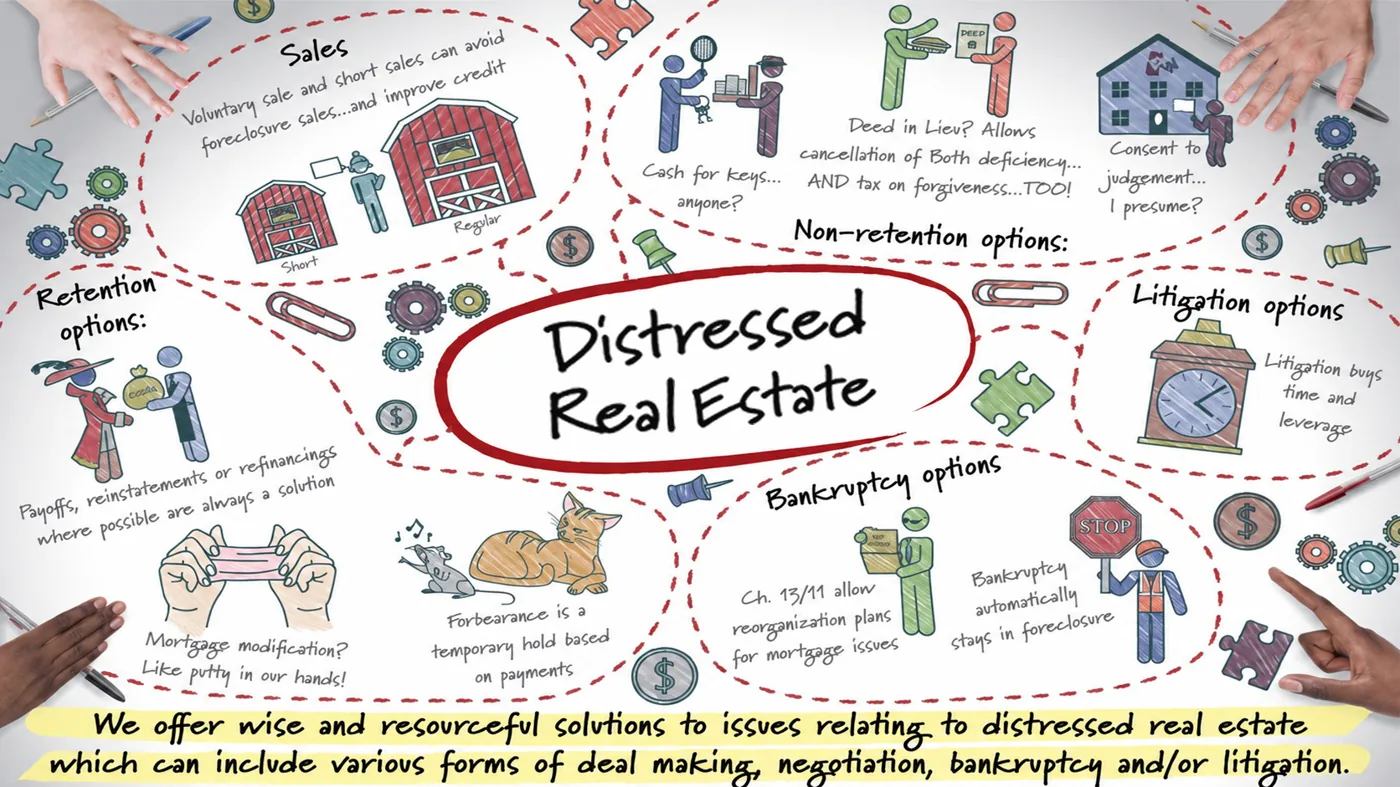
Non-Retention Options for Distressed Real Estate are options for a property owner who decides not to try to hold onto their home or other real estate that is distressed. The property owner either has decided that the home or other real property is not a viable place to continue to try to afford or the they have found better options in terms of home affordability and are ready to surrender the home or other real property in a negotiated settlement that takes into account the property owner's interests in such surrender. Those other interests include but are not limited to the following: time, cash, elimination of potential liability, elimination of real liability, better credit and the ending of a potential nuisance. The homeowner can potentially deal to obtain these benefits because the property owner has something to bargain with, namely the willingness to give up: various levels of ownership, possession and/or rights/steps in the foreclosure action. The lender usually is willing to trade with the property owner in some sort of fashion in return for such advantages. The Non-Retention Options can come in several forms and depend on the willingness of the lender to give the property owner sufficient consideration to continue the trade. Non-Retention Options can include: Third Party Voluntary and Short Sales, Deed in Lieu, Cash for Keys, Consent to Judgment and/or Abandonment of Property.

The initial difference between Retention Options and Non-Retention Options is that in the former, Retention Options, the main goal of the property owner is to find a way to keep the property, whereas in the latter, Non-Retention Options, the main goal of the property owner is the opposite, not to keep the property but to allow its loss or transfer while trying to extract maximum advantages for the property owner in exchange for the property. Usually, but not always, a property owner chooses Retention Options for their primary home and Non-Retention Options for a secondary property like an investment, rental, vacation or commercial property. However, choosing Non-Retention Options for even the property owners home can occur where there has been a major disruption in their lives like a serious consequential business setback, job loss, health issue and/or marital issue.
Non-Retention Options are used when the property owner either does not or can not maintain the property and rather than fight or delay a foreclosure has decided to bargain for other advantages such as cash, release from liability or potential liability and/or time. Usually a homeowner would prefer to go with the opposite, Retention Options, in order to stay in their homes if even remotely possible. The disadvantage of Non-Retention Options is balancing out the desire for a deal with the need to resist the foreclosure until the deal is obtained. The advantage is that Non-Retention Options are more straight forward than trying to keep a property with challenging payments.
Guiding Long Island, Queens and Brooklyn owners through distressed property decisions.
Schedule a Free Consultation
Our focus is simple: keep good people in the homes and lives they’ve worked hard to build.
Non-Retention Options are not always the same in what they give up in terms of aspects of property ownership. They can give up various forms of ownership and/or possession or litigation positions depending on the type of transaction agreed upon by the property owner and lender. The different aspects to ownership and/or possession that can be given up by the property owner are as follows:
"Possession" is the physical occupation of property through actually living at the property or renting it to others or having one's furniture and belongings still being at the property. Possession can also be in the form of using the property to operate a business. Possession can be given up with or without ownership also being transferred (ownership in the form of the real estate title or a formal transfer of the deed). During the majority of a foreclosure case, prior to the foreclosure auction, the owner still has title, but can agree to give up possession, while remaining an owner. When possession is given after the former property owner has already lost ownership and no longer is the title holder, the transfer of possession gives the buyer at a foreclosure sale all the elements of ownership: possession, title and the cutting off of the former owner's legal rights to the property. However, as long as the former owner is physically occupying a property with their belongings or still occupying the premises with their person, the lender or high-bidder need to evict him once they become the actual owner. A deal where possession is transferred is a "cash for keys" agreement where in exchange for delivering the keys and the property vacant and "broom clean" the lender agrees to give the property owner an agreed cash payment.
Legally, being the named party under the deed for the property (otherwise referenced as having "title" to the property) is the most important part of "ownership". The deed once it is transferred must be recorded to give notice to the world as to which version of the deed is the most recent and official version demonstrating ownership. The deed must ultimately be transferred in any voluntary real estate deal or involuntary foreclosure auction. The deed in a foreclosure action is actually transferred from the court assigned referee to the highest bidder at the auction; the high bidder first needs to give a downpayment after they prevail with their bid at the auction and pay the balance within 30 days, when the referee's deed is officially transferred to them. If the high bidder doesn't close within 30 days they risk losing their downpayment unless the referee allows an extension for the closing. However the deed can also be transferred prior to the property being foreclosed on in a "deed in lieu" agreement where the lender usually agrees not to seek a deficiency against the property owner. However, the lender would not usually agree to this remedy if there are significant secondary liens on the property (secondary mortgages and/or judgment liens by third parties) that have to be foreclosed on to obtain and sell clean title free of liens.
Giving the debtor a consent to proceed forward in a foreclosure proceeding by agreement is a way to move the foreclosure along in a situation where the property owner is not looking for additional time at the property. A property owner can consent to being served, to jurisdiction, to summary judgment or an order of reference, to appointing a referee, to a referee's report, to a judgment of foreclosure and sale, to the scheduling and notice for an auction, to the property being sold at the auction and to the referee's deed being transferred to the high bidder. Therefore there are many points at which the property owner can agree to consensually expedite the litigation and its conclusion. A foreclosure proceeding otherwise can be more protracted if the property owner is actively defending the foreclosure litigation. However, consenting to the various proceedings in the foreclosure action bypasses most of the potential litigation and allows the lender to schedule a foreclosure sale and conclude the property transfer relatively quickly. This is a viable remedy where a Deed in Lieu is not possible because of secondary liens by third parties against the property. Rather than giving the lender the deed, the property owner gives the lender consent to a quick foreclosure action so that they could expedite the foreclosure proceeding against all the liens on the property. Otherwise a Consent to Judgment of Foreclosure agreement, like a Deed in Lieu agreement, seeks to transfer rights from the property owner. The Consent to prevailing in the foreclosure is just not as close to the finish line, giving the lender the obligation to actually conduct a foreclosure auction to finalize the transfer of ownership. As with the Deed in Lieu agreement, a lender may in exchange agree to not to pursue the borrower for a deficiency.

The advantages in terms of what is obtained by the property owner in order to give up the above aspects of their ownership over the property, include but are not limited to the following non-Retention option advantages:
1. Time to Stay at the Property - The property owner may negotiate for time at the property for themselves, or for parties that they are trying to help like renters and/or family. The property owner may be able to get more time by defending the foreclosure but if the property owner is not interested in the expense and effort of litigation and/or already missed deadlines and advantages in the litigation, just bargaining as opposed to litigating to obtain more time may be a feasible alternative,
2. Cash for the Deed and/or Possession - The property owner may have already decided to move and therefore a relatively small amount of cash 3k-10k is usually what they can obtain at the end of a foreclosure action where the lender's path would be hard to stop and if the property owner has not defended. However, if the foreclosure gets bogged down and/or the property owner fights back and defends vigorously in the litigation there is a better chance for a transaction where the lender agrees to pay more to conclude the foreclosure action. Large payouts in cash may exceed 35k where lender realizes that the litigation may be involved, and potentially complex and costly
4. Better Credit - The homeowner may prefer allow the lender to sell the property at a foreclosure sale or to give ownership to the lender consensually to avoid title issues due to the fact that junior liens may be large enough to be significantly to interfere with a third party sale. Once the property is transferred the former owner can by agreement work with the lender to remove items on the credit report that show that the foreclosure is still in progress and substituting better items for the credit report that show that there is no longer a foreclosure proceeding and that the property owner settled and owes no deficiency or any other monies toward the property.
3. Elimination of Real / Potential Liability or Ending Possible Nuisance - As the owner of the property and the one liable for real estate taxes, ordinance compliance, and safety at the property, the property owner is liable for real estate taxes, meeting legal requirements, and for persons injured on or because of the property. To the extent the property owner isn't living at the property or earning income from the property, it can more more of a potential detriment to keep the deed and possession in his own name. This is true if the property is in a high crime area and could potentially be inhabited by squatter or visited by persons engaged in illicit activities such as illegal narcotics. Therefore, in such a situation giving the property to the bank is advantageous. The property could also become a possible nuisance if it houses problem tenants, or has inherent risks associated with the property, such as incomplete construction that is potentially dangerous, that are avoidable if ownership is transferred.
Maximum benefit for the property you surrender.
Schedule a Free Consultation
No more collection calls or sleepless nights, just a clear path forward with an experienced attorney at your side.
Free ConsultationThere are several different types of non-retention options where the advantage to the property owner varies and what is given up in terms of the legal and/or possessory rights also varies. Here are some of the options in terms of options where the property owner gives up some aspect of the property in return for other benefits:
A Voluntary Sale of the Property does require a formal agreement with the lender, as long as the lender receives a full payoff at the closing and all other liens or encumbrances on the property are paid and/or resolved. A Voluntary Sale is different than an involuntary sale at a foreclosure auction in that it is conducted and controlled by the property owner. A Voluntary Sale to a Third Party is considered a non-retention option because the property owner almost always needs to vacate after selling the property. A Voluntary Sale to a Friendly Party on the other hand is considered to be a Retention Option if the friendly party allows the property owner to remain in possession at the property. In a regular voluntary sale there is enough equity in the property to allow all liens to get paid in full and any profit, beyond paying necessary expenses at the closing, would go to the property owner.
A Third-Party Sale happens where unlike in a regular sale there is negative equity in the property and lenders need to allow a lessened payoff to close a sale. One of the most common non-retention options is a short sale to a third party which at the end causes the homeowner to have to turn over possession to the third party buyer. If the buyer is not friendly and or allied with the homeowner/ seller, the third party is looking to invest or possess the property and almost always wants to gain possession. A Voluntary Short Sale is different than a regular sale in that there is more owed in liens against the property than the proceeds available at the sale to pay off the liens. Therefore agreements are needed with any lien holder that is getting less than the full payoff of their claim. That is especially true of what is usually the first position lien on the property which is the main/first mortgage on the property. To do a short sale it is much simpler if there are no secondary liens against the property. However to the extent they exist they can be dealt with differently. Where first lien and/or secondary liens are very upside down, they may allow the closing for significantly less than what is owed to them as long as they are convinced that they received the best, or at least a reasonable deal under the circumstances. If there are multiple liens on a property they all need to agree to a lessened payoff amount to allow the sale to proceed or other terms that allow all the lien holders to release their liens. Typically the lenders agreeing to lessened payoffs also agree not to pursue a deficiency. Such forgiveness while it is common raises a question as to whether the former property owner would be on the hook for "debt forgiveness taxes" to the IRS which regards the forgiveness of debt as a taxable event unless the transferor is insolvent or was rendered insolvent by the transaction. Most homeowners in foreclosure can show that they are insolvent and therefore this potential tax is not usually an issue.
A "Deed in Lieu" agreement is a resolution to a foreclosure that gives the deed to the lender to avoid a the continuation of the foreclosure and potential liability by the property owner for a surplus. There are two issues with a "Deed in Lieu" arrangement. The first issue is one whether there are secondary liens on the property. If there are the "Deed in Lieu" Arrangement would usually not work for the lender who would still need to foreclose to eliminate the secondary liens. The second issue is whether the forgiveness of any liability for a potential deficiency would result in a tax to the property owner. Where the property is not an investment property and is the property owners home, there is usually an applicable exception to such tax based on an insolvency exception where the property owner was insolvent or rendered insolvent because of the transaction.
This is a popular Non-Retention option, especially when there are secondary liens and other potential encumbrances that may get in the way of a Short Sale or a Deed in Lieu which usually require that there be no other liens on the property other than that of the primary lender. Here what is given up is possession in return for a cash payment upon surrender of the keys and broom clean, permanent vacating of the premises with all of the property owner's belongings so the property is left broom clean. Cash for Keys is a more frequent option exercised at the end of a foreclosure or in the beginning of an eviction when the time for the property owner to leave may be near. However, where this deal is pursued in the beginning of a foreclosure it could result in a higher amount for the property owner, given the additional time that the foreclosure may take given that it only started.
Giving the debtor a "Consent Judgment of Foreclosure" agreement is a way to move the foreclosure along in a situation where the property owner is not looking for additional time at the property. A foreclosure proceeding otherwise can be more protracted if the property owner is actively defending the foreclosure litigation. However, consenting to the Judgment of Foreclosure essentially bypasses most of the potential litigation and allows the lender to schedule a foreclosure sale relatively quickly. A Consent to a Judgment of Foreclosure is a viable remedy where a Deed in Lieu is not possible because of secondary liens by third parties against the property. Rather than giving the lender the deed, the property owner gives the lender a quick foreclosure judgment so that they could expedite the foreclosure proceeding against all the liens on the property. Otherwise a Consent to Judgment agreement, like a Deed in Lieu agreement, seeks to transfer rights to the lender. The Consent to Judgment is just not as close to the finish line, giving the lender the obligation to actually conduct a foreclosure auction to finalize the transfer of ownership. As with the Deed in Lieu agreement, a lender may in exchange agree to not to pursue the borrower for a deficiency.
There are times where the property value has so declined because of potential liability, pollution or crime in an area, high taxes or onerous local government requirements or other problems associated with the property that the lender would not want the property even if the mortgage is not being timely paid. While abandonment of the property does not automatically transfer the deed, the non-payment of real estate taxes for several years may cause such abandonment.
Room to breathe again once the property is behind you.
Talk to an AttorneyThere are several administrative steps that must be implement to pursue Non-Retention Options as follows:
Almost all our files start in this way since it is important to understand the facts of the clients situation and to copy the essential documents that may influence or affect the matter. The retention agreement explains the task retained for, the rate of the fees the downpayment paid, when the balance would be due. To the extent we need to do searches or expend costs these need to be explained to the client and worked into the retention agreement. For a sale, short sale, or other matter typically there is a 1/2 down payment on the retainer with the balance usually due within a few weeks and/or at the closing, depending on the situation.
Searches are necessary for anyone typically engaging in a Non-Retention Option and needing to know about liens and secondary mortgages. (There are needed to see if a Short Sale or Deed in Lieu could proceed). There are several searches that many of the non-Retention Options require: title, lien, judgment, and/or bankruptcy searches. Besides that there is typically a credit report run, an appraisal done for real property if needed.
Certain costs are discussed and paid for in advance. In many cases it is desirable to have a formal appraisal for a property (like Short Sale or Short Pay negotiations). For searches like those discussed above and where applicable for filing and recording a quit claim deed, and/or other costs of buying or selling a property.
For Short Sale or a regular sale it is important to put the property up for sale with a broker. Even if one has a buyer for a Short Sale, typically a lender would not proceed unless it knew that the property was shown for at least a period of time (typically for 60 days) and that the proposed buyer is offering the highest price out of any other potential interested parties.
Typically in a Cash for Keys Arrangement, there is a day by which the property owner has to be totally out of the property and it needs to be left completely empty and broom clean with the keys delivered to representative of the lender.
It is vital to have an agreement in almost all Non-Retention Arrangement that looks out for our clients' interests and to do that it is wiser for us to draft the Settlement Agreement whenever possible. While the other party may have changes the essential part of a settlement, it is the settlement agreement which is intended to avoid disputes and ambiguity. Afterward it is up to the paralegal to assess the likelihood of a settlement and to draft a potential Settlement Agreement that would cause the other party to want to comply and if they do not, they give to our client the means to coerce.

When the pressure lifts, everything feels lighter. We help New York families get there, and stay there.
There are several reasons why our office is ideal to help with Non-Retention Options:

Let our office help you with Non-Retention Options. Getting started is simple:
The consultation is free, and the advice may be invaluable.
How our attorneys help you resolve mortgage debt and distressed property.
Our attorneys have represented Long Island and New York City clients since 1988. Schedule your free, confidential consultation today.