Empowering the Future: Our Annual Scholarship Essay Contest

Rewarding Bright Minds and Big Ideas

Each year, we award scholarships to exceptional students whose compelling essays showcase creativity, critical thinking, and a vision for positive change.

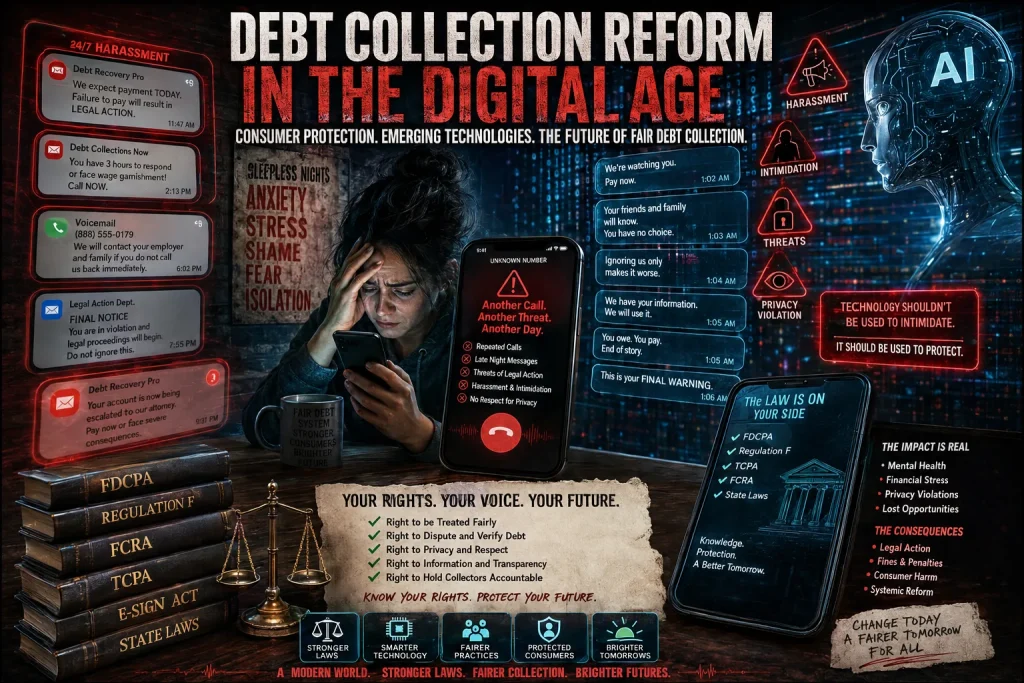
Debt Collection Reform in the Digital Age - Fall 2026 scholarship essay topic
Spring 2026 Contest Closed: Congratulations to our three Spring 2026 winners — view their photos and winning essays here.

Essay Topic:

Discrimination per 11 U.S.C. § 525 based on bankruptcy status.

Essay Topic:

Debt Collection Reform in the Digital Age: Consumer Protection, Emerging Technologies, and the Future of Fair Debt Collection

I.. Key legal authorities include:

  • 11 U.S.C. § 525

Introduction – Legal Background and Issues

Discuss the legal foundations governing discrimination based on bankruptcy status. Key legal authorities include:

  • 11 U.S.C. § 525 — Prohibits discrimination by governmental units (subsection (a)) and private employers (subsection (b)) solely because a person has filed for bankruptcy, been insolvent, or has not paid a discharged debt (ny-bankruptcy.comRoemerman Law).

  • Historical context: Perez v. Campbell (Supreme Court, 1971) struck down state laws that penalized bankruptcy filers, shaping § 525 protections (Roemerman Law).

  • New York City and New York State local anti‑discrimination laws — NYCHRL and NYC’s Stop Credit Discrimination in Employment Act (§ 8‑102(29), § 8‑107(24)) prohibit use of credit history including bankruptcy in hiring decisions (NYC).

Define core legal issues: What constitutes prohibited discrimination under § 525 and local law? Where do protections start, and what limits remain?


II. Legal Challenges – Why Are There Disputes in This Area?

Explore contested questions and real‑world friction points:

  1. Scope of § 525: Courts differ on whether § 525(b) prohibits private employers from making hiring decisions based on past bankruptcy filings, or only protects current employment. Some circuits allow hiring-based discrimination despite § 525(b) covering termination/hiring (St. John’s Law Scholarship RepositoryDivision of Human Rights).

  2. Proving causation: Employers may cite unrelated reasons for adverse employment actions, which can complicate enforcement. Disentangling bankruptcy‐motivated firing or demotion from legitimate misconduct remains a challenge (Roemerman Law, Sasser Law Firm).

  3. Overlap with credit history bans: Even where § 525 protects, employers in NYC and NY may still consider bankruptcy data through credit checks—an apparent conflict between federal and local laws.

  4. Bankruptcy in broader civil rights context: Emerging scholarship (like Melissa Jacoby’s Unjust Debts) suggests systemic racial disparities in who files and benefits or suffers from bankruptcy, implicating civil rights and equal protection concerns (Axios).


III. Trends – Emerging Movements and Legal Resolution

Identify recent shifts in legislation, case law, and public policy:

  • Legislative expansion: NYC’s 2015 Stop Credit Discrimination Act bans use of credit history—including bankruptcy filings—in hiring/employment decisions, strengthening protection beyond § 525 (NYC).

  • Judicial divergence: Circuit splits remain on whether § 525 covers pre‑employment screening. Some circuits exclude hiring decisions; others interpret broadly. There is no Supreme Court resolution yet (St. John’s Law Scholarship RepositoryUnited States Courts).

  • Increased enforcement and awareness: Employees have begun filing EEOC or NYCHRL claims when terminated or not hired after bankruptcy filings. Agencies scrutinize the correlation between filing and adverse action more closely (Derek Smith Law Group).

  • Critical scholarly framing: Legal academics and civil rights advocates emphasize how bankruptcy intersects with racial and economic inequality, advocating for reforms that expand access to bankruptcy relief and mitigate disparate impact (Axios).


IV. Essay Questions

Below are four to six possible essay prompts. Each is suitable for a 2,500‑word analysis. State which question(s) you select when writing your essay.

  1. Question 1: Analyze the legal scope and limits of 11 U.S.C. § 525. Should its protections extend explicitly to hiring decisions? Evaluate circuit splits and recommend a path forward.

  2. Question 2: How do local laws such as the NYC Stop Credit Discrimination Act and NYCHRLinteract with federal § 525 protections? Should federal law be amended to close gaps and harmonize with state/local anti‑credit‑check restrictions?

  3. Question 3: Consider a hypothetical: A private New York employer ends the candidacy of an applicant immediately after discovering a recent bankruptcy. Outline the legal claims available (federal § 525, NYCHRL, EEOC), and assess the employer’s likely defenses.

  4. Question 4: Discuss the policy and civil rights implications of current bankruptcy anti‑discrimination law. Does the existing regime adequately address racial and socioeconomic disparities raised by critics like Jacoby? Propose meaningful reforms.

  5. Question 5: Evaluate whether employers’ use of bankruptcy information via consumer credit reports should be categorically banned or allowed with restrictions. What balance should courts and legislatures strike between employer informational interests and debtor privacy/protection?

  6. Question 6: Trace the historical development of protections against bankruptcy discrimination—from Perez v. Campbell (1971) to § 525’s adoption, and the emergence of local anti‑credit laws. How has legal interpretation evolved, and what lessons does that history hold for future reform?


Summary

This frames the intersection of bankruptcy law and employment discrimination, centering on § 525, local credit history bans, judicial interpretations, and broader policy debates. You may pick one or more of the above questions. Be sure to:

  • Use legal citations (statutes, cases, regulations).

  • Take a clear position and support it with authority and policy reasoning.

  • Briefly define your chosen essay question(s) at the outset.

I. Key Legal Authorities and Background

Discuss the legal framework governing consumer debt collection practices in the United States and how technological advancements have transformed communications between creditors, debt collectors, and consumers.

  • 15 U.S.C. § 1692 et seq. — Fair Debt Collection Practices Act (FDCPA)
    • Purpose of the FDCPA to eliminate abusive, deceptive, and unfair debt collection practices.
    • Definitions of “debt collector,” “consumer,” and prohibited conduct.
    • Historical context and congressional intent.
  • 12 C.F.R. Part 1006 (Regulation F)
    • Implementation of the FDCPA by the Consumer Financial Protection Bureau.
    • Modern rules governing electronic communications, voicemail messages, emails, text messages, call frequency limits, and validation notices.
  • Fair Credit Reporting Act (15 U.S.C. § 1681 et seq.)
    • Accuracy of consumer credit reporting.
    • Responsibilities of furnishers and debt collectors.
    • Consumer dispute rights.
  • Telephone Consumer Protection Act (47 U.S.C. § 227)
    • Restrictions on automated telephone calls.
    • Robocalls and text messaging.
    • Consumer consent requirements.
  • Electronic Signatures in Global and National Commerce Act (E-SIGN Act)
    • Electronic communications and legally sufficient consumer notices.
  • State Consumer Protection Statutes
    • Mini-FDCPA statutes.
    • State deceptive practices acts.
    • Licensing requirements for debt collectors.
  • Relevant Case Law — potential cases for research include:
    • Jerman v. Carlisle, McNellie, Rini, Kramer & Ulrich LPA
    • Henson v. Santander Consumer USA Inc.
    • Obduskey v. McCarthy & Holthus LLP
    • TransUnion LLC v. Ramirez
    • Federal appellate decisions interpreting electronic communications under Regulation F.

Define the core legal issues: How should decades-old consumer protection statutes apply to modern methods of debt collection, including email, text messaging, artificial intelligence, predictive dialing systems, social media, and digital payment platforms?

II. Legal Challenges and Contested Issues

Explore the principal legal questions surrounding modern debt collection.

  • Artificial Intelligence in Debt Collection
    • AI-assisted communications.
    • Automated negotiations.
    • Chatbots interacting with consumers.
    • Due process and transparency concerns.
  • Electronic Communications
    • Consumer consent.
    • Email delivery.
    • Text message validation notices.
    • Privacy concerns when messages are viewed by third parties.
  • Harassment in the Digital Age
    • Frequency limits under Regulation F.
    • Whether repeated electronic messages constitute harassment.
    • Balancing creditor rights with consumer privacy.
  • Identity Theft and Wrong-Party Collection
    • Increased reliance on automated databases.
    • Collection against the wrong consumer.
    • Verification obligations.
  • Credit Reporting Issues
    • Reporting disputed debts.
    • Accuracy requirements.
    • Furnisher liability.
  • Data Privacy
    • Storage of financial information.
    • Cybersecurity concerns.
    • Use of consumer data by third-party collection agencies.
  • State versus Federal Regulation
    • Whether stronger state protections should supplement the FDCPA.
    • Preemption concerns.

III. Emerging Trends and Policy Considerations

Identify recent developments affecting debt collection law.

  • Expansion of Artificial Intelligence
    • Predictive analytics.
    • AI-generated communications.
    • Automated payment arrangements.
  • Consumer Financial Protection Bureau Initiatives
    • Regulation F implementation.
    • Enforcement priorities.
    • Proposed guidance regarding emerging technologies.
  • Digital Communication Preferences
    • Shift from telephone calls to email and text messaging.
    • Consumer expectations regarding privacy and convenience.
  • Growth of Medical Debt Collection
    • Increasing regulation of medical debt reporting.
    • State reforms.
    • Consumer protections.
  • Consumer Privacy Legislation
    • Interaction with emerging state privacy laws.
    • Data minimization.
    • Consumer consent.
  • Future Legislative Reform — potential reforms may include:
    • Modernization of the FDCPA.
    • Federal regulation of AI debt collectors.
    • Enhanced disclosure requirements.
    • Stronger consumer verification rights.
    • National standards governing electronic communications.
    • Greater civil penalties for repeated digital harassment.

IV. Essay Questions

Below are possible essay prompts suitable for a ~2,500-word analysis. State clearly which question(s) you select in your submission.

Question 1

Analyze whether the Fair Debt Collection Practices Act adequately protects consumers from modern digital collection practices. Should Congress amend the FDCPA to address artificial intelligence, text messaging, and electronic communications? Why or why not?

Question 2

Evaluate whether Regulation F appropriately balances creditors’ legitimate collection efforts with consumers’ privacy rights in today’s digital environment.

Question 3

Discuss how courts have interpreted the FDCPA in the context of emerging technologies. Have judicial decisions kept pace with technological advances, or is legislative reform necessary?

Question 4

Assume a debt collection agency utilizes artificial intelligence to communicate with consumers through text messages, chatbots, and automated email systems. Analyze the potential legal issues under the FDCPA, Regulation F, the Telephone Consumer Protection Act, and applicable consumer protection laws.

Question 5

Assess whether federal law should impose additional restrictions on the use of artificial intelligence in consumer debt collection. What legal safeguards should be implemented to protect consumers while preserving legitimate collection practices?

Question 6

Trace the evolution of consumer debt collection law from the enactment of the FDCPA in 1977 through today’s digital marketplace. How have technological advances challenged existing legal frameworks, and what reforms should policymakers consider for the future?

Summary

This topic examines the evolution of consumer debt collection law as technology transforms the methods by which creditors and debt collectors communicate with consumers. Essays should:

  • Cite relevant statutes, regulations, and judicial decisions.
  • Analyze both federal and state consumer protection laws where applicable.
  • Take a well-supported legal position based on statutory interpretation, case law, and policy analysis.
  • Clearly identify the selected essay question(s) at the outset.
  • Address both legal doctrine and the practical implications of digital debt collection practices.
  • Consider the competing interests of consumer protection, creditor rights, technological innovation, and regulatory modernization.
Fall 2026 Contest Now Open: We are accepting submissions for the Fall 2026 essay topic from September 1, 2026 through January 1, 2027 at 11:59 PM. See the topic and application below.

    Please make sure to add your essay maximum 2500 words before you press submit!

    PLEASE ATTACH YOUR ESSAY HERE*:(Please use a word doc or PDF)

    if can’t attach can send essay as a separate email ([email protected])

    Part B - The Application

    Cartoon-style blue bottle with a rolled-up piece of paper inside, resembling a message in a bottle, symbolizing distant communication or mystery**Application for Fall 2026 Scholarship Contest**

    Application Deadline - July 15th, 2026

    Read and follow the instructions carefully prior to submitting your application.


    If selected, you will be asked for documentation to support the data you provide. Likewise, all correspondence and award agreements will be generated from the personal information submitted in the box. So, please use proper spelling, capitalization, and punctuation.


    Cartoon-style illustration of three figures in conversation, with speech bubbles showing introductions like 'My Name is...', 'I Live at...', and 'Hello...', representing a basic communication or introduction scenario.I. Tell Us About Yourself


    Illustration of a stack of three books, with the top blue book labeled 'College Courses' and a red bookmark sticking out, representing educational materials.II. Educational Status


    collegeIII. Students currently enrolled in University:


    IV. CHOICE OF THREE SHORT INFORMATIONAL ANSWERS

    Below is a choice of three (3) short informational answers A, B, or C. Please pick one and give us a short informational response of approximately 200-250 words (not a strict word count). This descriptive answer should be input directly into one of the empty essay portal boxes below - A, B or C - depending on which question you select to answer.

    Illustration of a newspaper titled 'News About You' featuring a bar chart with three vertical bars and a pie chart divided into three colored segments, symbolizing personal data or statisticsA. Describe Yourself & Any Accomplishments or Activities in Your Life That You Wish to Share

    Tell us about any accomplishment, event, hobby, recreation, sport and/or activity that is important to you and explain how and why it is meaningful to you.

    Cartoon-style illustration of a knight with a sword and shield confronting a two-headed dragon breathing fire labeled 'challenges & hardship,' symbolizing the battle against adversity.B. Discuss any Challenges and/or Hardships in Your Life That You Wish to Share

    Feel free to describe a challenge or hardship faced by yourself or your family and explain how have dealt with it and/or how you overcame it.

    FAQ 0008 DoorsC. Discuss Your Educational Goals & Career Aspirations

    Tell us about your educational goals and career aspirations.

    Part C **Sign and Submit**

    Applicant's E-Signature


    Coin Life Preserver

    By signing (typing your legal name) in the space below, you are certifying that all information is correct and that you are the person completing this application. When you press the submit button, you will receive an email confirmation that your application was received. Please print a copy for your records and retain as verification of your application.

    A smiling man stands indoors holding a large ceremonial check for $3,500 made out to Correy Freeman for winning first place, dated 9/12/2025. The room has blinds, a desk, and items on shelves in the background.

    About this Essay Contest and Educational Scholarship

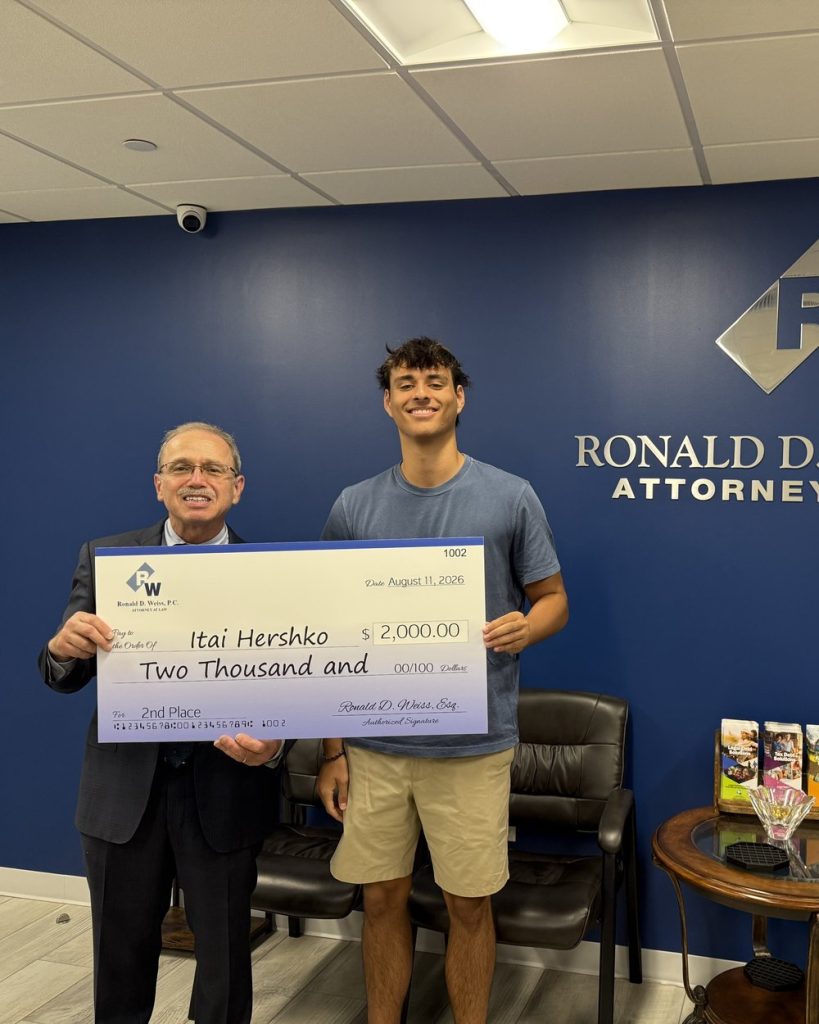
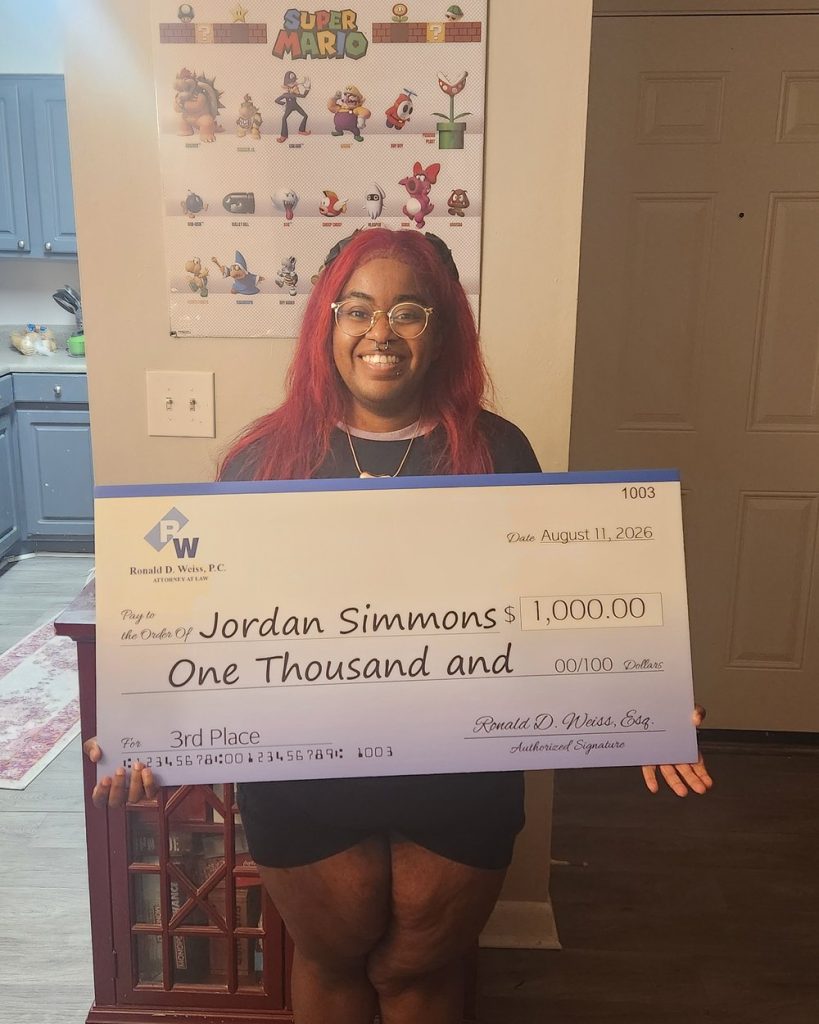
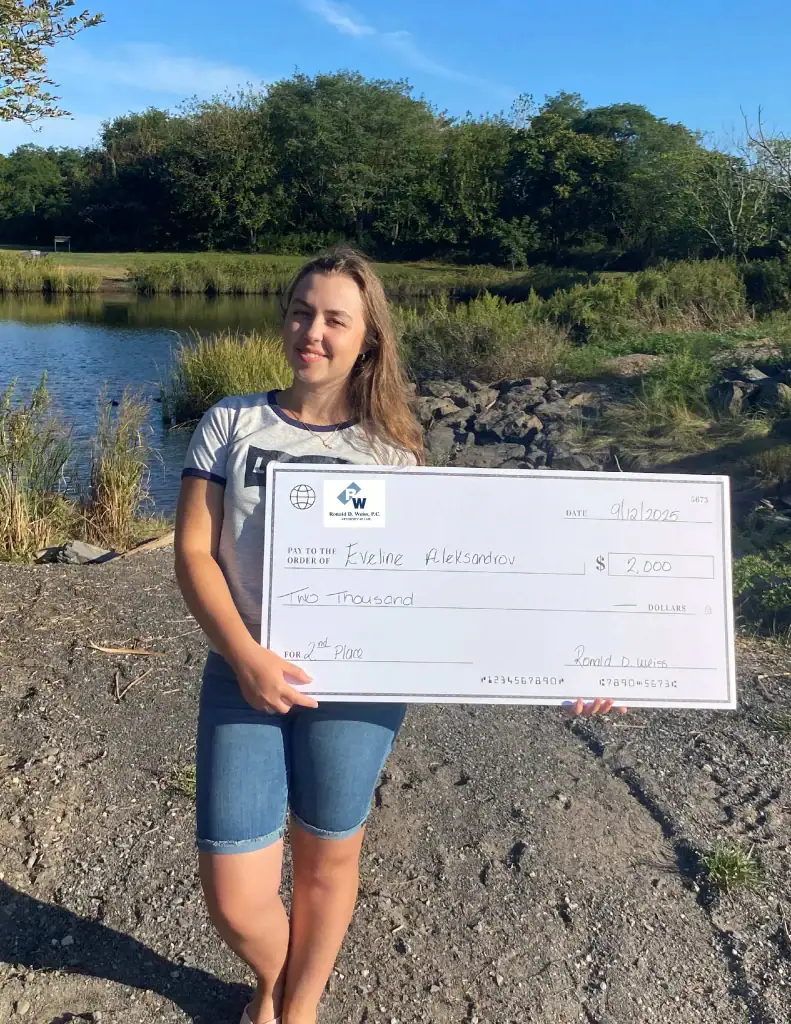
    In an effort to help college and/or graduate school students meet their educational costs, the Law Office of Ronald D. Weiss, P.C. is pleased to offer incoming and existing college and/or graduate school students an opportunity to win a total of $6,500. in prizes, twice per year. Every Spring and Fall we hold this Essay Contest and award three (3) prizes. The current prizes consist of a $3,500. 1st prize, a $2,000. 2nd prize and a $1,000. 3rd prize. The biannual scholarship and selection for the three (3) scholarship awards is based on an essay contest where the contestants take a position on a relevant topic that is unique for each contest. The Essay Topics for each contest deal with current legal and policy issues pertaining to debt relief.

    A young woman stands outdoors by a lake, holding a large check for $2,000 made out to Eveline Aleksandrov for 2nd place. She is wearing a casual t-shirt and shorts, smiling at the camera.

    Eligibility

    In order to be eligible to apply for the scholarship, applicants must fit the following criteria:

    • Good Standing – Be in good academic standing with your current educational institution.
    • Age – If under 18, have the permission of your parent or guardian to apply. 
    • Country / Citizenship – There is no restriction on students outside of the United States or non-citizens of the U.S. entering the contest.
    • Language / Laws – The submissions, including the essay, must all be in English and the essay must be based on U.S. laws and policies.
    • Recognized Academic Institution – The academic institution to where the applicant is currently enrolled and/or enrolled next year, needs to a recognized educational institution currently offering an academic educational curriculum to a body of students. However, the educational institution can be outside of the United States, and the student can be taking courses on-line or on a part-time basis. To qualify, the program in which the student is enrolled needs to be at least six (6) months in length and result in a certificate or degree.
    A smiling young man stands in front of a red wall, holding a large ceremonial check for $1,000 made out to Daniel Dalrymple for 3rd place, dated 9/12/2025 and signed by Ronald D. Weiss.

    A Message for All Contestants

    Thank you for participating in this biannual essay writing contest. We are honored and humbled by the many promising students who have participated in the Essay Writing Scholarship Contest offered by our law office, since we started it in 2014, and by the many excellent essays that these talented students have submitted. If you do not win the Current Essay Contest, please do not be discouraged and please try again in six (6) months since the the contest is offered biannually, every Spring and Fall. But if you are one of the three (3) new the Winners, a BIG kudos to you and a sincere Thank You for your winning submission. All winning essays will be proudly displayed on this website together with an image of their authors, in tribute to the promise, energy and intelligence of current and future scholars and their potential to tackle our society’s legal, policy and economic challenges.

    A man with a beard stands indoors, holding a large novelty check for $1,000 dated 3/20/2025, made out to Kenneth Mars for third place, signed by Ronald Weiss. The check is from Ronald D. Weiss, PC.

    Deciding on This Current Contest’s Winning Essays

    The following factors will be considered in determining the three (3) winning essays in every biannual essay writing contest:

    • A demonstrated understanding of the issues raised;
    • Originality;
    • Quality of writing; and
    • The applicant’s demonstrated potential for success in a field related to law, policy and/or government.

    Three (3) winners for each biannual essay writing contest are chosen with the 1st prize being $3,500., the 2nd prize being $2,000. and the 3rd prize being $1000. The prizes are sent to the three (3) winners of each contest approximately four (4) to six (6) weeks after the end of a contest. We ask that winners send us a picture of themselves with the large “presentation check” that we will mail together with the actual award check and allow us to post their photo with their winning essay to encourage future students to participate.

    All decisions are final and are subject to the discretion of the staff of the Law Office of Ronald D. Weiss, P.C. where our attorneys and staff are the judges and read every essay.

    A woman smiles while holding a large check made out to Dana Morrison for $3,500, dated 3/20/2025, awarded for 1st place from Ronald D. Weiss, P.C. She stands indoors near a glass paneled door.

    Requirements for the Winners

    Winners must respond to the emails and/or calls of our office and acknowledge that they are the applicant. They must give us their current address for us to send the display check together with the real award check. The winners must take a picture of themselves with the display check and send the picture to our office via email. Winners need to agree to allow us to post on our website the picture of themselves with the display check. This is needed to encourage future applicants to the scholarship. Winners also must agree to allow us to display their winning essay on our website. Again, the purpose of this posting of winning essays is to encourage further participation in the scholarship. Our office intends to offer this scholarship for the foreseeable future, and we are delighted by the growing amount of student participation since we started.

    Top