Chapter 7 Bankruptcy Lawyer Suffolk County

Wipe the Slate Clean and Keep What New York Protects

Discharge qualifying debt in about 3 to 4 months, with a Suffolk filing heard at Central Islip and handled from offices in Melville and Bohemia.

Since 1988 · 6 attorneys, 25+ staff · Avvo 10.0. Free and confidential. No obligation.
The Ronald D. Weiss legal team, serving Suffolk County Chapter 7 filers since 1988
1988Serving New York since
5.0Google client rating
FreeConfidential case review
~4 moTypical time to discharge
Chapter 7 in Suffolk County

Chapter 7 in Suffolk County

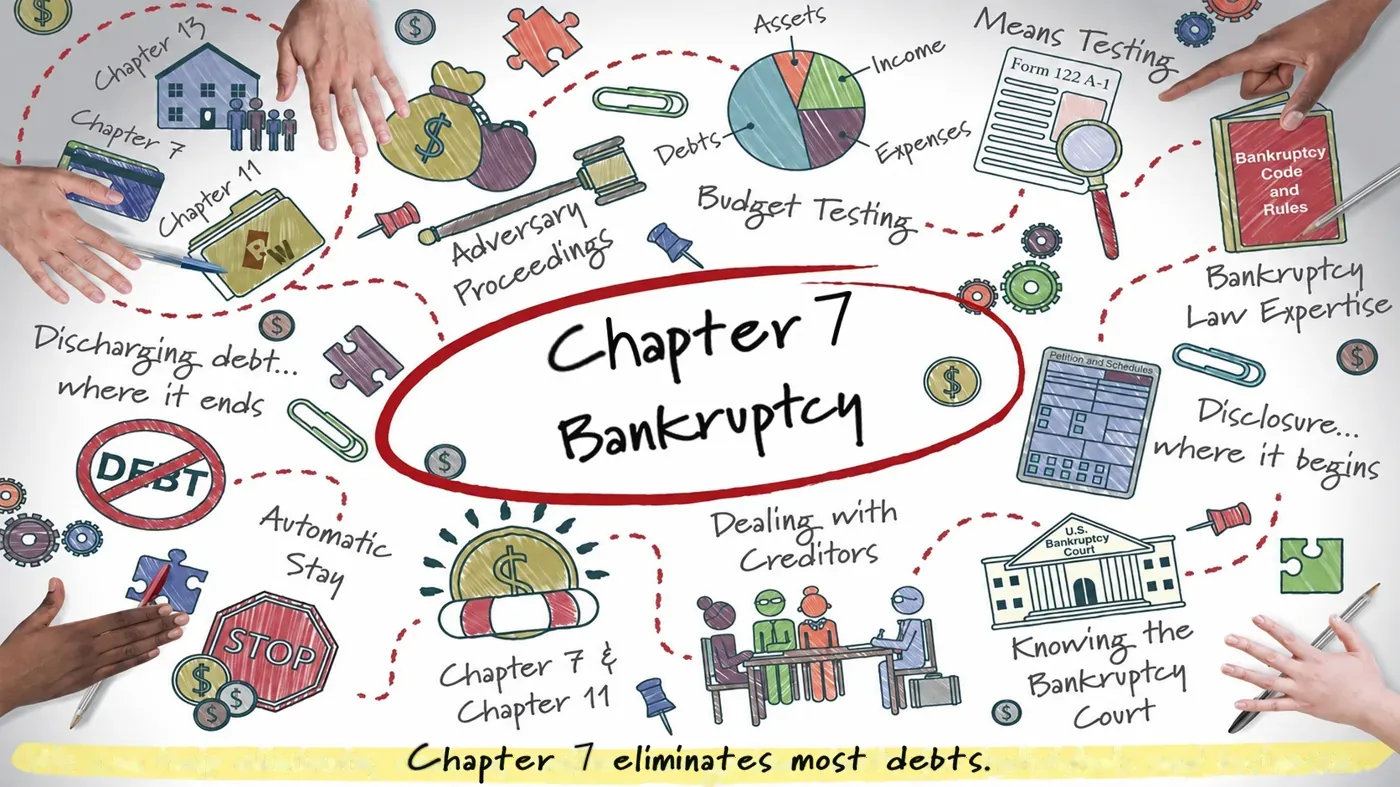
Chapter 7 eliminates most debts.

  • Serving Suffolk County
  • Keep exempt property
  • Free consultation
What a Chapter 7 Bankruptcy Lawyer in Suffolk County Does

Liquidation, the fast path to a discharge

A Chapter 7 bankruptcy lawyer in Suffolk County files a liquidation petition that erases qualifying unsecured debt and delivers a discharge in roughly three to four months.

Petition and schedules illustration

Chapter 7 wipes out qualifying unsecured debt, credit cards, medical bills, and personal loans, and delivers a discharge in roughly three to four months. The case is heard at the U.S. Bankruptcy Court for the Eastern District of New York, Central Islip division, at 290 Federal Plaza, which sits inside Suffolk, so your 341 meeting of creditors stays inside the county instead of a haul to the Brooklyn courthouse.

Pie graph illustration

Since 1988 this firm has run the New York means test, elected the state exemptions that let most Suffolk filers keep everything they own, invoked the automatic stay to freeze collection the day the petition is filed, and carried cases from that first Central Islip filing through discharge. Below is a plain-English guide to how Chapter 7 works for a Suffolk County household, what you protect, whether you qualify, and how our firm helps at every step.

Relieved clients enjoying a fresh financial start at home
Chapter 7 & the Means Test

The means test measures your gross income against family size, with discounted treatment for housing, insurance, support and car payments. Earn too much for Chapter 7, and Chapter 13 may let you repay a percentage over five years.

Bankruptcy in General

Bankruptcy resolves debt without needing creditor approval. Chapter 7 eliminates debt, Chapter 13 reorganizes it for individuals and Chapter 11 for businesses, and each stops collection with the automatic stay and ends in a discharge.

Your Bankruptcy Discharge

A bankruptcy discharge is a court order at the end of your case that permanently cancels credit card, personal loan, medical and most other debts. Unlike debt consolidation, it is fast, final and based on your finances.

The Automatic Stay

The automatic stay starts the second a bankruptcy is filed and stops collection calls, lawsuits, wage garnishments, bank restraints, car repossessions and foreclosures. A creditor who knowingly violates it can be sanctioned or made to pay damages.

Household Means Testing

Household size sets your means test income limit: the bigger the household, the higher the limit. Courts start with your tax return but may count who lives with you, and you may still need a negative budget.

Creditors Meeting & Disclosure

At the creditors’ meeting, the bankruptcy trustee reviews your schedules and asks about your finances, and creditors can ask questions too. What you disclose there can decide whether your case moves forward, so preparation matters.

Petitions, Schedules & Disclosure

Your bankruptcy petition, schedules and statement of financial affairs must disclose your property, debts, income, exemptions and any asset transfers. Disclosure must be truthful, and issues it raises often need to be resolved in advance.

What Chapter 7 Discharges for Suffolk County Residents

The debt that disappears, and the collection that halts

Chapter 7 is built to wipe out unsecured debt, and the automatic stay freezes collection the moment your petition hits the Central Islip docket.

Stop sign illustration

Chapter 7 wipes out unsecured debt: credit card balances, medical bills, personal and payday loans, old deficiency balances, and most judgments a Suffolk collector has already won. It does not erase child support, most recent taxes, or student loans outside of a hardship showing, and we tell you which of your balances actually clear before you file, not after.
Bankruptcy code book illustration

The moment the petition hits the Central Islip docket the automatic stay takes effect, which freezes wage garnishment, empties the threat out of a bank levy, stops a repossession, and makes it illegal for collectors to keep calling. For a Suffolk household drowning in revolving debt, that is the difference between treading water and standing on solid ground within a season.

Means-test form illustration

Your case is heard at the U.S. Bankruptcy Court for the Eastern District of New York, Central Islip division, at 290 Federal Plaza, which sits inside Suffolk. The filing, the assigned Chapter 7 trustee, and the 341 meeting of creditors are all inside the county you live in, so the one appearance the process requires is a short, local one. A Chapter 7 341 meeting is brief when the paperwork is right, and we prepare you for the exact questions the Central Islip trustees ask about income, assets, and recent transfers.

House illustration

Upon the filing of the Chapter 7 case, you are immediately protected from your creditors with an “automatic stay.” A secured creditor not getting regular post-petition payments, such as mortgage or car loan payments, can move for relief from the automatic stay, which in a Chapter 7 case would usually be granted unless you can quickly cure the amount in arrears. Your debt collection lawsuits run through Suffolk County District Court, and any foreclosure runs through the Suffolk County Supreme Court, whose foreclosure part sits at the Cohalan Court Complex in Central Islip, so we coordinate the bankruptcy with whatever is already moving against you in those Suffolk courtrooms.

The Automatic Stay

Instant protection the day you file

The moment your Chapter 7 case is filed at Central Islip, the automatic stay takes hold and Suffolk collectors must stop. Here is what that means for you.

Creditors must immediately stop all collection activity
Bank restraints are released
Wage garnishments stop
Collection calls, letters & lawsuits pause
Wondering if Chapter 7 can wipe out your Suffolk County debt?A free, confidential review with an attorney can tell you in minutes.
Get My Free Consultation
Family relaxing together in their living room
A fresh start you can build a life on. Suffolk County families have already turned the page.
New York Exemptions That Protect Your Suffolk County Home and Assets

Chapter 7 is not a fire sale of your life

Almost no Suffolk Chapter 7 filer surrenders anything, because New York exemptions cover ordinary belongings and a good deal more. New York does not permit the federal exemption set, so Suffolk filers use the state system, and its homestead exemption protects home equity up to the downstate figure, roughly $204,825 for this county. Here is how the New York amounts compare with the federal set for reference.

Protected Asset
New York
Federal
Homestead Your primary residence
New York$204,825 per owner-occupant
Federal$31,575 indiv. / $63,150 couples
Motor vehicle
New York$4,825
Federal$5,025
Wildcard Any personal property
New York$3,575
Federalup to $15,800 $1,675 + unused homestead
Household goods
New York$11,975 + certain items
Federal$16,850
Personal-injury award
New York$9,000
Federal$31,575
Tools of the trade
New York$3,575
Federal$3,175
Federal exemption amounts effective April 1, 2025; New York amounts current as of 2025.
Petition and schedules illustration

The word liquidation frightens people, but in practice almost no Suffolk Chapter 7 filer surrenders anything. On top of the homestead exemption, the state protects a motor vehicle, tools of your trade, which matters for the county’s tradespeople and 1099 earners, retirement accounts, and everyday household goods. What diminishes the potential “equity” in a particular asset are liens, such as mortgages and car loans, and statutory exemptions which protect a certain amount of value that, under the law, is unavailable to creditors, summarized in the table above.

Pie graph illustration

Getting the exemptions claimed correctly is most of the case, and it is a deliberate decision here, not a form filled in by default. Most Suffolk clients keep all of their property, including their vehicles, homes, and personal possessions, as long as they stay current with the payments and do not have too much equity. If a married couple files together, in many instances they can double the exemption protections. When a mortgage arrears problem is the real issue rather than unsecured debt, Chapter 7 may be the wrong tool, and we will say so.

Serving Suffolk County and Long Island
Local Suffolk Counsel Since 1988

Chapter 7 representation filed at Central Islip, from offices in Melville and Bohemia.

Get My Free Consultation
Excellent ★★★★★ 5.0 | Google reviews
Section 03

Avoidable transfers, the look-back periods

Certain payments or transfers you made before filing can be “avoided” (undone) by the trustee. What looks like an innocent transaction can sometimes qualify, so timing your Suffolk filing matters.

90 Days
Preferences
Payments to ordinary third-party creditors before filing can be recovered by the trustee.
1 Year
Insider transfers
Payments or transfers to relatives or close associates within a year of filing.
6 Years
Fraudulent transfers
Transfers for less than reasonable value, usually to relatives or close associates.
Stop sign illustration

Closely related to the issue of potential equity in assets is the issue of “avoidable transfers.” These can be “preferences,” or payments to creditors made 90 days prior to the bankruptcy case for third-party creditors, or one year prior to the filing for “insiders” (relatives or close associates of the debtor). These can also be “fraudulent transfers,” or transfers for less than reasonable value six years prior to a bankruptcy case, usually made to relatives or close associates. Avoidable transfers are not always obvious, and what can appear to be an innocent transaction can, under bankruptcy law, potentially be alleged to be an avoidable transfer, which is one more reason we plan your Suffolk filing deliberately rather than filing on the first date available.

Plan ahead.

We review your recent transactions before filing so nothing becomes a surprise “avoidable transfer” later in your case.

Worried a recent payment could be an “avoidable transfer”?We review your timeline before filing at Central Islip so there are no surprises.
Get a Free Case Review
Smiling family with their baby at home
Real Relief

A fresh start for the whole family

Chapter 7 can eliminate most or all of your qualifying debt, giving your Suffolk family room to breathe, save, and move forward with confidence.

Do You Qualify, the Chapter 7 Means Test for Nassau and Suffolk

Qualifying is a calculation, not a guess

To file Chapter 7, your household income generally must fall below the New York median for your household size, or you must pass a means test based on your allowed expenses. The New York median-income figures below are current as of April 1, 2026.

$73,272
1-person household
NY median income
$92,902
2-person household
NY median income
$115,579
3-person household
NY median income
$139,040
4-person household
+$11,100 each add’l dependent
Bankruptcy code book illustration

Chapter 7 eligibility runs through the means test, which compares your household income against the New York State median for a family of your size. Below the median you generally qualify outright. Above it, a second calculation subtracts allowed living costs, and Suffolk realities pull many earners back under the line: a downstate mortgage or high rent, the long commute, and childcare all count against income. Even if you are over the median, there is often “wiggle room” when your expenses are for basic necessities like housing, utilities, food, and clothing, which effectively lower your counted income.

Means-test form illustration

The test uses a six-month average, which matters more in Suffolk than in tighter Nassau, because so much Suffolk income is self-employed, 1099, trades, hospitality, and East End seasonal work that swings from month to month. Timing the filing after a slow stretch can be the move that qualifies a household, and we plan that month deliberately instead of filing on the first date available. Because the average household income on Long Island is higher than in many other parts of New York State, it is important to carefully average your gross household income for the six months prior to filing. Where the gross household income does not pass the means test, you can still obtain relief under Chapter 13, which does not carry the same income limits as Chapter 7.

House illustration

Even if a “border-line” client barely squeezes through the means test, they also need to pass the “budget test,” which looks at present net income (after taxes) and regular expenses to determine whether the budget, not including obligations dischargeable in the Chapter 7 case, is negative, which allows a potential Chapter 7 filing, or positive and showing a surplus of disposable income, which would disqualify the client for Chapter 7 eligibility.

Timing is a strategy in Suffolk.

Because so many Suffolk households earn 1099, trades, hospitality, and East End seasonal income, the six-month average swings with the calendar. A strong stretch can be balanced by a slow one, so we choose the filing month deliberately rather than filing on the first available date.

Family who kept their home
The Weiss Difference

A fresh financial start for Suffolk families, most debts eliminated, your future reclaimed.

Get My Free Consultation
Section 05

Debts that survive bankruptcy

Chapter 7 discharges most unsecured debt, but some categories generally cannot be wiped out. We map which of your Suffolk balances clear before you file, not after.

Most student loans

Rarely dischargeable, only via an “undue hardship” showing, which is very difficult to prove.

Recent income taxes

Tax debt under ~3 years old is not dischargeable. Older tax (with returns timely filed) may qualify.

Child & spousal support

Domestic support obligations are generally not dischargeable.

Fraud & willful injury

Debts from fraud, a crime, malicious injury, or concealing assets can be excepted from discharge.

Petition and schedules illustration

Chapter 7 is built to wipe out unsecured debt, but some categories are not dischargeable. Most student loans, recent taxes, and child and spousal support survive. There are exceptions: “undue hardship,” which is extremely difficult to prove, can potentially allow the discharge of student loans. Income tax debt older than three years, where the debtor filed a return two years before the bankruptcy filing, is also potentially dischargeable, though sales and withholding taxes, as fiduciary taxes, are never dischargeable. Child and spousal support are generally not dischargeable. Some acts make debt non-dischargeable, such as fraud, a crime, a malicious injury, and the concealment of assets. In some cases the creditor or trustee must file an adversary proceeding within 60 days after the first Central Islip creditors’ meeting to object to the discharge, a contested proceeding within the bankruptcy case.

Objection window.

To challenge a discharge, a creditor or trustee must generally file an adversary proceeding within 60 days of the first creditors’ meeting, a contested proceeding within your bankruptcy case.

Parents lifting their child by a sunny window
Life After Debt

Back to the moments that matter

No more collection calls or sleepless nights, just a clear path forward, with an experienced Suffolk attorney in your corner every step of the way.

Free Consultation
Chapter 7 vs Chapter 13 for Long Island Filers

One honest recommendation, not a bigger fee

Chapter 7 erases qualifying debt fast and suits filers who pass the means test and want a clean break in a few months. Chapter 13 is the reorganization route, a three to five year plan that cures mortgage arrears to save a home. If you are current on your Suffolk home and buried in credit cards, Chapter 7 is usually the answer. If you are behind on the mortgage and fighting to keep the house, Chapter 13 often is. We run your numbers and give the honest recommendation at the free consultation, never the chapter with the larger fee. When the case crosses county lines, a Long Island bankruptcy lawyer on the same team carries it across Nassau and the rest of the Island, and the chapter-agnostic view for this county lives on our bankruptcy lawyer in Suffolk County page. A few more issues we evaluate with every Chapter 7 client before filing.

Reaffirming Debt

Keeping certain debts

If a client wants to keep certain debt, and remain obligated to pay it, they can reaffirm the debt, signing an agreement, filed with the bankruptcy court, stating that the client, after consultations with their attorney, has freely decided to keep the debt. When it comes to credit card and other unsecured debt, there is usually little advantage to reaffirming, since new credit will usually be available after the bankruptcy case without the client committing themselves to repay old debt. It is not necessary to reaffirm any debt, other than potentially secured debt against a vehicle, which per the 2005 Bankruptcy Amendments is supposed to be reaffirmed if the client wishes to keep their vehicle. However, the reality is that most bankruptcy judges disfavor reaffirmations where the client’s budget is negative (which is the norm). Therefore, most lenders for vehicles (with the possible exception of Ford) are not strict about requiring reaffirmation agreements, and are usually satisfied without one if the client remains current with post-petition payments.

Avoiding Judicial Liens

Liens against your home

While the Chapter 7 case can eliminate unsecured debt against the debtor himself, it cannot do the same for secured liens filed against the debtor’s property. To the extent that, prior to the bankruptcy filing, a creditor had obtained a judgment and liened it against the client’s home, the client can move to avoid the judicial lien based on its interfering with the client’s exercise of their homestead exemption. If there is no equity in the client’s home other than equity protected by the homestead exemption, such a motion can successfully avoid the judicial liens against the client’s property.

“Abusive” Debt & Good Faith

Pre-filing planning

There is also the potential issue of the abusive incurring of debt prior to filing. Incurring a large amount of cash advances and balance transfers shortly before filing may be monitored by creditors and/or the trustee, who may object to the discharge of such debt. In some cases where the client has incurred such recent “cash” debt, a certain amount of payments and waiting are advisable prior to filing the bankruptcy case.

A related issue is budgetary items on the Chapter 7 schedules that appear exaggerated, such as large car payments on luxury vehicles, an excessive number of vehicles, or payments on unnecessary items such as boats, vacations, and/or secondary homes. In some cases, if such luxury spending were taken out of the budget, the client would no longer qualify for Chapter 7 and would have a positive budget. In other cases the qualification is unaffected, but the excessive spending should still be curtailed as part of pre-filing planning, to show the client is not taking advantage of the bankruptcy system.

A couple enjoying life again after debt relief
Life After Chapter 7

Steady footing again, and room to enjoy the life you’ve worked for in Suffolk County.

Talk to an Attorney
Section 07

Your path to discharge at Central Islip

The goal of every Chapter 7 case is the discharge, a court order that permanently forgives your qualifying debt. In Suffolk it runs about three to four months, and the arc is predictable.

1
Weeks 1 to 2

File Your Petition

Free consultation, we gather documents, run the means test, and file when ready, which triggers the automatic stay and stops collection.

2
Weeks 4 to 6

341 Meeting at Central Islip

Your 341 meeting of creditors at Central Islip, typically brief once the paperwork is clean.

3
~60 Days After

Discharge Granted

The discharge order arrives and the qualifying debt is legally gone, making the stay’s protection permanent.

Pie graph illustration

The goal in each Chapter 7 case is to obtain a “discharge” order, or legal forgiveness for the debt, so that you obtain a “fresh start” and can rebuild your credit. The discharge makes permanent what the automatic stay protected against temporarily, so that most of your unsecured debts are now legally forgiven. There are some exceptions: most student loans, most taxes, and most child or matrimonial support obligations. Most Suffolk clients discharge all of their unsecured debt, although you are able to voluntarily keep or “reaffirm” certain debts.

Parents hugging their children at home
In Your Corner

Protecting the people you love

Our focus is simple, to keep good Suffolk families in the homes and lives they’ve worked hard to build.

Chapter 7 Bankruptcy Attorney Suffolk County NY

A firm that files, not a settlement mill

Chapter 7 is the most frequently used bankruptcy case, but it can be complex. We review your circumstances closely so nothing complicates your fresh start.

Stop sign illustration

The pages above us on this search are multi-county template firms, an out-of-state attorney, and directories, and not one of them can name the courthouse your case goes to or the exemption that saves your equity. We can, because we file at Central Islip and appear in the Suffolk district and foreclosure parts every week, from local offices in Melville at 445 Broadhollow Rd, 631-212-1046, and in Bohemia at 80 Orville Dr, 631-223-4502. Your case is handled by an attorney, not a call center, at a flat fee written into the agreement before we begin and never padded afterward, and the first consultation costs nothing. This is a full law firm with 6 attorneys and 25-plus staff, which means we can file motions and invoke the stay rather than just mail letters to your creditors.

Bankruptcy code book illustration

The credentials behind that are verifiable: an Avvo 10.0 “Superb” rating and a 4.9 aggregate, a Martindale-Hubbell 5.0, a BBB A+, and a 2026 Super Lawyers selection, with a founder who clerked for a U.S. Bankruptcy Judge and published bankruptcy scholarship at NYU Law. That is authority the directory listings on this page simply do not have. The firm represents Chapter 7 clients throughout the Eastern District of New York, whose Central Islip division sits inside Suffolk, from our offices in Melville and Bohemia.

Law Offices of Ronald D. Weiss, P.C., Melville, Long Island
Eliminate overwhelming debtCredit cards, medical bills, personal loans, and repossession/foreclosure deficiencies.
~4-month resolutionMost cases resolve quickly, letting you rebuild your credit sooner.
Keep your propertyCareful exemption planning protects your home, vehicles, and possessions.
Experienced court representationRegular practice at the Central Islip bankruptcy court, right in Suffolk County.

Our consultations are free, and the advice may be invaluable.

Not Sure How to Deal With Your Debt?

Free Consultation Available Now

In a free consultation, we go through your situation and your options with you, and decide on a plan of action.

Creative Legal Solutions to Your Debt Challenges video

Creative Legal Solutions to Your Debt Challenges. See how we deliberate with you and strategize which options best apply to your situation, and how to best resolve your debt challenges.

Free Chapter 7 Bankruptcy Consultation in Suffolk County

See if Chapter 7 is even your best move

We have represented Suffolk County and Long Island clients since 1988. Free consultation. Available 24/7 at 888-4-U-NEW-START, or call the Melville office at 631-212-1046.

The Ronald D. Weiss legal team
↑ Top