(631)-271-3737,
QUEENS
(718)-751-0226
(516)-307-0262,
BROOKLYN
(347)-508-9316,
BOHEMIA
(631)-223-4502

(631)-271-3737,
QUEENS
(718)-751-0226
(516)-307-0262,
BROOKLYN
(347)-508-9316,
BOHEMIA
(631)-223-4502

Wipe out most of your debt and start fresh
Credit cards, medical bills, personal loans and old judgments: Chapter 7 can erase them in a few months, and in most cases the trustee finds nothing to sell.
888-4-U-NEW-START (888-486-3978)Click to callFree consultation with Ron, by phone or at one of our offices.


Ronald Weiss and his team made the process of filing for Chapter 7 Bankruptcy very smooth. From the first meeting with Mr. Weiss where he explained that I could file for Bankruptcy. To the last meeting with the Bankruptcy Trustee, and my case was closed. Everything went through without any problems. I would highly recommend Ronald Weiss and his team.
Ronald Weiss helped me get a discharge order in my Chapter 7 bankruptcy case. I appreciate the efforts of his office to find solutions to my financial troubles during a difficult time in my life. His advice and helpful planning has made this process a lot less painful. Now that we have dealt with my credit card problems I will retain his services to help me obtain a modification.

A fresh start in months, not years
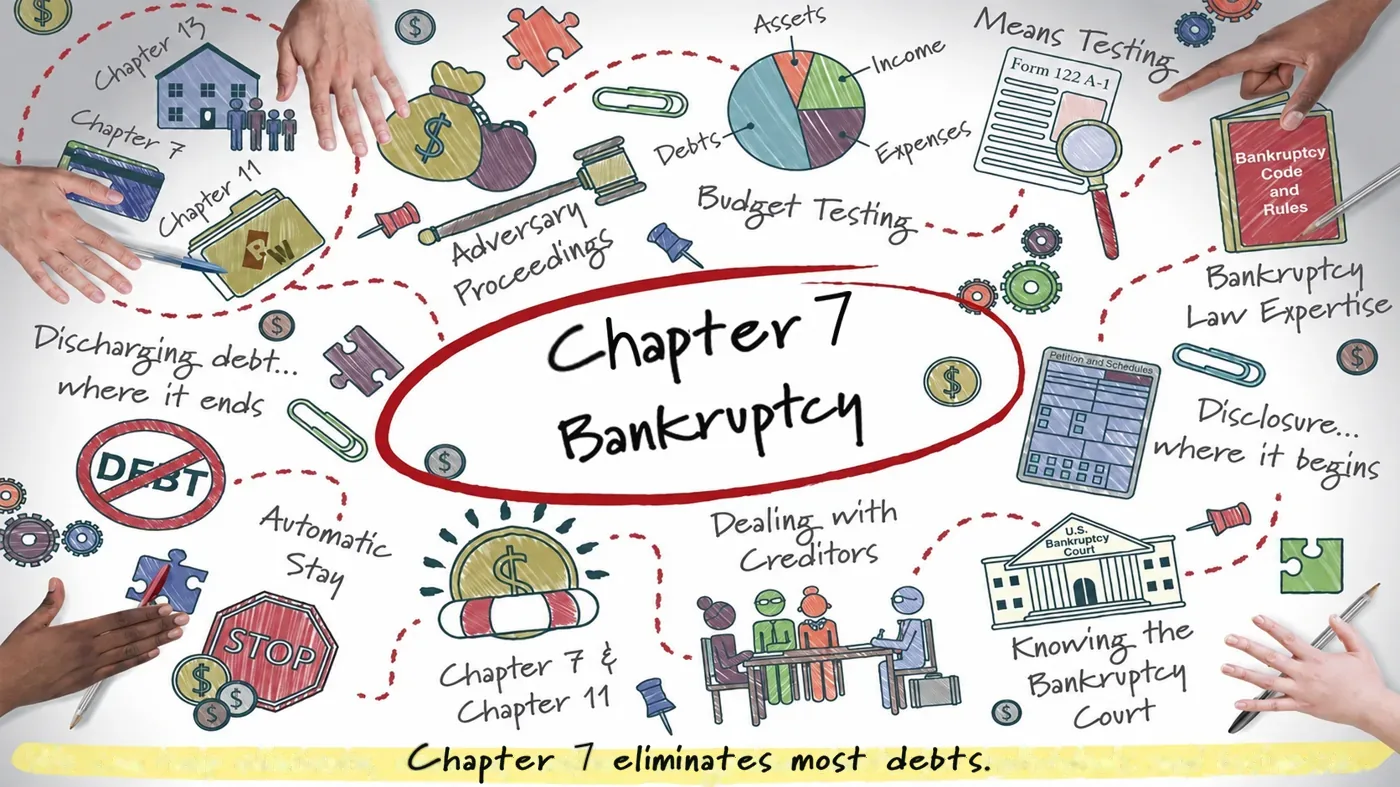
Chapter 7 eliminates most debts.
A trustee, one short meeting, then a discharge

Chapter 7 is the bankruptcy chapter that wipes out debt. A court-appointed trustee reviews what you own, can sell only what the law doesn't protect, and the court then discharges most of what you owe. Of all of your bankruptcy options, it is the fastest.
The law calls it liquidation, but most Chapter 7 cases for individuals are "no asset" cases: everything the filer owns is exempt or tied to a loan, so the trustee has nothing to sell.
The discharge usually arrives 60 to 90 days after the first date set for your meeting with the trustee, roughly three to four and a half months after filing.
Leaving aside cases that are dismissed or switched to another chapter, individuals get a discharge in more than 99% of Chapter 7 cases.
For most filers, Chapter 7 takes the debt and leaves the belongings.
The income line and the cost to begin

Chapter 7 starts with the means test, which looks at what your household earned in the six months before filing and holds it against the state median for that many people. For cases filed on or after July 15, 2026, the medians are:
Under the line, you generally pass. Over it, a second step subtracts allowed living costs, and many families still qualify. Here is how the Chapter 7 means test works in detail.
There is no debt limit in Chapter 7, high or low; the federal caps apply to Chapter 13.
Two more rules: an approved credit counseling course taken within 180 days before filing, and no case dismissed in the last 180 days for missing court or ignoring its orders.
If the numbers point the other way, a Chapter 13 repayment plan may fit instead. We run both at the consultation.
For the full picture, see what it costs to file Chapter 7.
Over the median isn't the end of the test. It's the start of the second half.
Every deadline the court sets, in order
Cases from Long Island, Brooklyn, Queens and Staten Island are filed with the Eastern District of New York, and the steps below follow its checklist. Manhattan and Bronx cases follow the same federal rules in the Southern District.

Counseling and your consultation.
Finish an approved credit counseling course within 180 days before filing. We go through your income, debts and property with you and run the means test.

The petition.
We file it with your schedules of what you own and owe, and the $338 fee (or the installment or waiver request).
Fourteen days for the rest.
Any papers not filed with the petition are due within 14 days, or the case can be dismissed. Certain listed items still missing at day 45 bring an automatic dismissal on day 46.
Documents to the trustee.
Pay stubs from the 60 days before filing and your latest tax return go to the trustee at least 7 days before the meeting.

The meeting of creditors.
It falls 21 to 40 days after filing and is held on Zoom. Have your original photo ID and Social Security card with you; we prepare you for the trustee's questions.
The money course.
A financial management course certificate must be filed no later than 60 days after the meeting's first scheduled date.

The discharge.
Usually 60 to 90 days after that first meeting date, unless someone objects.
Most of the work happens before filing day.

Bankruptcy is the most effective way to deal with debt.
Book My Free ConsultationCalls, lawsuits and garnishments, on hold

The moment the petition is filed, the automatic stay takes effect. While it lasts, creditors generally can't:
New York already caps a wage garnishment at 10% of gross income. The stay stops even that share while your case is open.
Two limits to know. If a case of yours was dismissed in the last 12 months, a new filing may not get the stay's full protection, so tell us about it.
And Chapter 7 can only delay a foreclosure; catching up a mortgage takes Chapter 13.
Emergency petitions can go in within 24 to 48 hours, and the same day when a deadline demands it.
The stay gives you quiet. The discharge makes it last.
New York's exemptions, at today's amounts
What a trustee can't touch is set by exemptions. New York's amounts below took effect April 1, 2024, and change next on April 1, 2027.
New York shields a set amount of home equity where you live, whether a house, co-op shares, a condo or a mobile home: $204,825 in New York's top tier, which covers New York City, Long Island, Westchester, Rockland and Putnam.
Equity above that is what a Chapter 7 trustee can sell. If that's you, read will you lose your house in Chapter 7? and talk to us before filing.
Up to $5,500 of equity in one vehicle, more if it's equipped for a disability. Still paying it off? You can reaffirm the loan before the discharge and keep driving. See can you keep your car in Chapter 7?
Social Security, unemployment, public assistance, veterans' and disability benefits, support payments and qualified retirement accounts are protected. So are everyday household goods.
Cash and bank deposits are covered up to $6,825, but only if you aren't claiming a homestead. A renter's rent-stabilized lease is exempt too.
New York lets you choose the federal exemptions instead. For a filer with little home equity, the federal list can protect more; we compare the two with your numbers.
Our article on New York bankruptcy exemptions goes item by item, and what happens to an inheritance in bankruptcy covers money that arrives after you file.
Most debts end; a short list survives

A Chapter 7 discharge ends your personal liability for most debts, and those creditors can never again sue or collect on them. That covers credit cards, medical bills, personal loans and most old judgments.
These stay with you if they aren't paid in the case:
A discharge also leaves liens in place: a mortgage or car loan still secures the property. When keeping a house or car matters more than speed, compare Chapter 7 vs Chapter 13.
The discharge is a court order, not a payment plan.
About 2,800 Long Island cases a year
Nassau County and Suffolk County cases are filed with the Eastern District's courthouse at 290 Federal Plaza, Central Islip. Meetings of creditors for those cases have been held on Zoom since October 1, 2023, so most filers never travel there.
In the 12 months to June 30, 2026, Long Island filed 2,771 Chapter 7 cases: about 39% of the district's 7,057, and about 55% of all bankruptcies filed on the island. In Brooklyn, Chapter 7 is closer to 70%.
That gap is mostly income and home equity. Long Island households more often earn above the median or own a house worth protecting, so the choice of chapter matters more here.
Walk in without an appointment at our Melville main office on Route 110, close to where Nassau County meets Suffolk County. Mineola and Bohemia see clients by appointment.
On Long Island, picking the chapter is half the case.

Same law, local details
Chapter 7 is federal law everywhere in New York, but the court, the income picture and the local collection rules change with your address.
Choosing the right chapter in a county of homeowners.
The busiest filing county, run on its own numbers.
From a Civil Court lawsuit to a stopped garnishment.
Manhattan, the Bronx and Staten Island, borough by borough.
Every bankruptcy option for Queens households.

Bankruptcy law since 1988, and Ron at your first meeting

Ron started out clerking in the bankruptcy court, for Judge Prudence B. Abram of the U.S. Bankruptcy Court for the Southern District of New York.
Before that came NYU Law's John J. Galgay Fellowship in Bankruptcy and Reorganization Law.
His article, "The Contempt Power of the Bankruptcy Court," appeared in the Bankruptcy Developments Journal in 1989. You can look it up.

Your first consultation is with Ron himself, in person or by phone. After that you work with an attorney directly, not an intake coordinator, backed by a full firm of attorneys and legal staff.

Practicing since 1988, and admitted since 1992 in the Eastern District, which hears Long Island cases, and the Southern District.

A debt settlement company can't file motions or invoke the automatic stay. We can, and we can also negotiate or defend a lawsuit when Chapter 7 isn't the right tool.

Consultations in English and Spanish (Hablamos Español), and our team also speaks Hindi, Urdu and Russian.
Avvo 10.0 Superb · BBB A+ · Super Lawyers 2026 · Martindale-Hubbell Client Champion Platinum 2026
A judge's former clerk, still meeting every new client himself.
Find out if Chapter 7 fits before you file
Bring your pay stubs and the bills that worry you most. Ron runs the means test with you, checks what New York protects, and tells you plainly whether Chapter 7, Chapter 13, a settlement or no filing at all is the better move.
Our legal consultations are free, but our advice may be invaluable.

About three to four and a half months, and most filers never set foot in a courtroom:
You can still qualify. The second part of the means test subtracts allowed expenses (housing, insurance, car payments, support) and asks what's left over a five-year window. Many households over the median pass it. If yours doesn't, Chapter 13 is usually the next step.
No. Chapter 7 is available whatever the amount of your debts, high or low. The new federal ceiling of $2.75 million in combined debt applies to Chapter 13, not to Chapter 7. What decides Chapter 7 is income and property, not how much you owe.
Our side works like this:
Every cost is disclosed in a written agreement before you sign anything.
In most cases, yes, from the day you file. The automatic stay generally halts collection suits, wage garnishments and bank restraints, and the discharge then erases the debt behind them. An earlier case dismissed within the past year can weaken that, so tell us about any past filing.
Four honest ones. Property New York doesn't protect can be sold. Some debts survive, like support and most government student loans. Liens stay on a house or car. And it can't catch up missed mortgage payments; that takes Chapter 13. The filing also shows on your credit, though the firm reports that most of its clients see their credit measurably improve within a year of filing.
Often, if the equity fits within New York's exemptions and you're current on any loan. Equity above the protected amount is the risk. Our articles walk through will you lose your house in Chapter 7? and the car in detail.
The law doesn't require one, but the federal courts' own guide tells filers to get legal advice before filing because the discharge has so many exceptions. A lawyer also chooses your exemptions, prepares you for the trustee and answers a creditor who objects.
Chapter 7 if your income passes the means test, your property fits the exemptions and you mainly need debt erased. Chapter 13 if you earn more, have equity to protect, or need time to catch up a mortgage or car. We weigh both with your real numbers.
When you need time instead of a discharge.
The two personal chapters, side by side.
The income test, line by line.
Every chapter we file, laid side by side.
Start with one free conversation
Call or walk in at Melville. Ron runs your numbers, puts every cost in writing, and when a garnishment or lawsuit can't wait, the filing can move fast.
Available 24/7.