(631)-271-3737,
QUEENS
(718)-751-0226
(516)-307-0262,
BROOKLYN
(347)-508-9316,
BOHEMIA
(631)-223-4502
(631)-271-3737,
QUEENS
(718)-751-0226
(516)-307-0262,
BROOKLYN
(347)-508-9316,
BOHEMIA
(631)-223-4502
A Nassau Chapter 7 filing erases qualifying credit card, medical, and personal loan debt and stops the creditor calls the day it hits, with an attorney who appears in the court your case is assigned to.


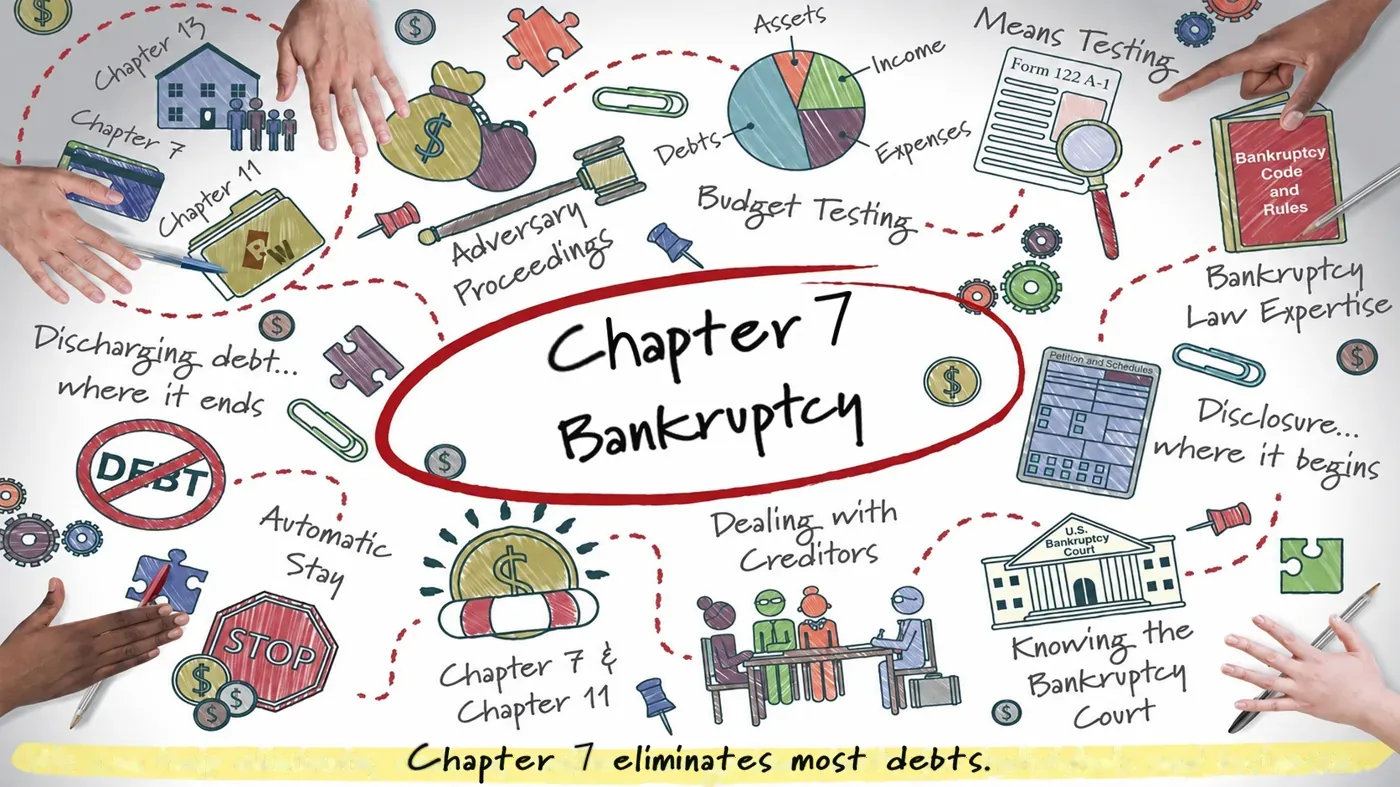
Chapter 7 eliminates most debts.
A Chapter 7 bankruptcy lawyer in Nassau County files a liquidation petition that discharges your qualifying unsecured debt, typically within three to four months of filing.

The petition discharges qualifying unsecured debt, meaning credit cards, medical bills, and personal loans, and it triggers the federal automatic stay the instant it is docketed, which freezes wage garnishment, bank levies, and collector calls right away.

Eligibility runs through the New York means test, and what you keep is set by the New York exemptions you elect. Since 1988 this firm has taken Nassau households through exactly that process, from the first free call to the discharge order.

The means test measures your gross income against family size, with discounted treatment for housing, insurance, support and car payments. Earn too much for Chapter 7, and Chapter 13 may let you repay a percentage over five years.
Bankruptcy resolves debt without needing creditor approval. Chapter 7 eliminates debt, Chapter 13 reorganizes it for individuals and Chapter 11 for businesses, and each stops collection with the automatic stay and ends in a discharge.
A bankruptcy discharge is a court order at the end of your case that permanently cancels credit card, personal loan, medical and most other debts. Unlike debt consolidation, it is fast, final and based on your finances.
The automatic stay starts the second a bankruptcy is filed and stops collection calls, lawsuits, wage garnishments, bank restraints, car repossessions and foreclosures. A creditor who knowingly violates it can be sanctioned or made to pay damages.
Household size sets your means test income limit: the bigger the household, the higher the limit. Courts start with your tax return but may count who lives with you, and you may still need a negative budget.
At the creditors’ meeting, the bankruptcy trustee reviews your schedules and asks about your finances, and creditors can ask questions too. What you disclose there can decide whether your case moves forward, so preparation matters.
Your bankruptcy petition, schedules and statement of financial affairs must disclose your property, debts, income, exemptions and any asset transfers. Disclosure must be truthful, and issues it raises often need to be resolved in advance.
The automatic stay is federal law, and it takes effect the moment the petition is filed, not weeks later.

Your Nassau Chapter 7 case starts when the petition, schedules, and statement of financial affairs are filed with the bankruptcy court. Those documents disclose your assets, liabilities, income, and expenses as of the filing date, and the instant they are docketed the federal automatic stay takes hold.

The stay halts wage garnishment and bank levies, freezes a debt collection lawsuit already moving through Nassau County District Court, and makes it illegal for collectors to keep calling. For most Chapter 7 filers that is the turning point: the phone goes quiet, the paycheck comes home whole, and there is finally room to breathe while the case runs to discharge.

Before filing, you complete a short pre-filing credit counseling session, by phone or online, with a counselor who reviews your finances privately. We gather the documentation for your file first, including proof of income, tax returns, and bank statements, so your creditors and debts are listed correctly on your schedules.

When a foreclosure sale is the emergency rather than unsecured debt, the automatic stay pauses it but does not cure the arrears, so a secured lender not receiving regular post-petition payments can move for relief from the stay. In that situation we will tell you plainly if a repayment plan is the better tool for saving the home.
The moment your Nassau Chapter 7 case is filed, the automatic stay takes hold and creditors must stop. Here is what that means for you.

Chapter 7 erases qualifying unsecured debt outright, but it does not touch a mortgage or car loan you keep paying, and what you protect is decided by the exemption set you elect. New York lets a filer choose the state set or the federal set. Here is how they compare.

Chapter 7 erases qualifying unsecured debt: credit card balances, medical bills, personal loans, and old deficiency balances. It will not clear most student loans, recent taxes, or child support, and it does not touch a mortgage or car loan you want to keep paying. What you keep is decided by the exemption set you elect. For the downstate counties that include Nassau, the New York state homestead exemption protects roughly 204,825 dollars of home equity, alongside protection for a vehicle, retirement accounts, and household goods (summarized in the table above).

Picking the set that shields the most of what you actually own is a deliberate decision we make before filing, not a box checked by default, and it is the difference between a clean discharge and a lost asset. Most Nassau Chapter 7 filers keep everything they own as long as they stay current on secured payments and their equity fits within the exemptions, and a married couple filing together can often double those protections. Even where some equity falls outside the exemptions, we can negotiate a settlement payment with the Chapter 7 trustee so you keep the asset rather than see it sold.
Chapter 7 representation for Nassau County households, from Mineola.
Schedule a Free ConsultationCertain payments or transfers you made before filing can be “avoided” (undone) by the trustee. What looks like an innocent transaction can sometimes qualify, so timing matters.

Closely related to the equity in your assets is the issue of “avoidable transfers.” These can be “preferences,” meaning payments to ordinary creditors made within 90 days of filing, or within one year for “insiders” (relatives or close associates). They can also be “fraudulent transfers,” meaning transfers for less than reasonable value within six years of filing, usually made to relatives or close associates. Avoidable transfers are not always obvious, and a Nassau household paying back a family member or moving property before filing can trigger one without realizing it, which is exactly why we map your recent transactions first.
We review your recent transactions before filing so nothing becomes a surprise “avoidable transfer” later in your case.

Chapter 7 can eliminate most or all of your qualifying debt, giving your Nassau family room to breathe, save, and move forward with confidence.
Eligibility runs through the means test, which compares your household income to the New York State median for your household size. The New York median-income figures below are current as of April 1, 2026.

Nassau is one of the denser, higher-cost inner suburbs in the state, so a paycheck that looks large on paper is often carrying an outsized Nassau mortgage, a Long Island Rail Road commute, and childcare. The means test compares your average gross income over the six months before filing to the New York median for your household size, and once those allowed expenses come off, many higher earners land back under the line. The test applies when your debt is primarily consumer debt rather than business debt, and expenses for basic necessities such as housing, utilities, food, and clothing effectively lower your counted income.

When income sits above the median, the second half of the test measures your disposable income after those deductions, and self-employment or a recent job change can shift the result. Because Nassau household income runs higher than in much of New York State, this is exactly where a close case is won or lost, so we average your actual six-month gross income carefully rather than guess. If the gross household income does not pass the means test, you can still obtain relief under Chapter 13, which does not carry the same income limits as Chapter 7.

Even a borderline filer who squeezes through the means test must also pass the budget test, which looks at present net income after taxes against regular expenses. If that budget, excluding debts to be discharged, runs negative, a Chapter 7 filing is available; if it shows a surplus of disposable income, it can disqualify you. We run the actual math on your numbers first, because assuming you earn too much is the single most common reason a Nassau family waits too long to file.
The Coronavirus Aid, Relief and Economic Security (“CARES”) Act, signed into law on March 27, 2020, made some substantive changes to the bankruptcy laws. For Chapter 7, the CARES Act tried to allow easier access to relief by not including, in the income counted for the means test, the extra federal assistance added to unemployment insurance (an extra $600 per week, which later went down to an extra $300 per week).
A fresh financial start: most debts eliminated, your future reclaimed.
Schedule a Free ConsultationChapter 7 discharges most unsecured debt, but some categories generally cannot be wiped out. Knowing which is which is central to planning your Nassau case.
Rarely dischargeable, only via an “undue hardship” showing, which is very difficult to prove.
Tax debt under ~3 years old is not dischargeable. Older tax (with returns timely filed) may qualify.
Domestic support obligations are generally not dischargeable.
Debts from fraud, a crime, malicious injury, or concealing assets can be excepted from discharge.

Chapter 7 wipes out qualifying unsecured debt, but most student loans, recent taxes, and child and spousal support survive. There are narrow exceptions: “undue hardship,” which is extremely difficult to prove, can allow a discharge of student loans, and income tax older than three years, where the return was filed at least two years before the bankruptcy, may be dischargeable. Sales and withholding taxes, as fiduciary taxes, are never dischargeable. Support obligations are generally not dischargeable, with a very narrow exception for a settlement as distinguished from a payment obligation. Certain acts also except debt from discharge, such as fraud, a crime, a malicious injury, or the concealment of assets. To object to a discharge, a creditor or trustee generally must file an adversary proceeding within 60 days after the first Nassau creditors’ meeting, which is a contested proceeding within the bankruptcy case.
To challenge a discharge, a creditor or trustee must generally file an adversary proceeding within 60 days of the first creditors’ meeting, a contested proceeding within your bankruptcy case.

No more collection calls or sleepless nights, just a clear path forward, with an experienced attorney in your corner every step of the way.
Free ConsultationA few more issues we evaluate with every Nassau Chapter 7 client before filing.
If a client wants to keep certain debt, and remain obligated to pay it, they can reaffirm the debt: sign an agreement, filed with the bankruptcy court, stating that the client, after consultations with their attorney, has freely decided to keep the debt. When it comes to credit card and other unsecured debt, there is usually little advantage to reaffirming, since new credit will usually be available after the bankruptcy case without the client committing themselves to repay old debt. It is not necessary to reaffirm any debt, other than potentially secured debt against a vehicle, which per the 2005 Bankruptcy Amendments is supposed to be reaffirmed if the client wishes to keep their vehicle. However, the reality is that most bankruptcy judges disfavor reaffirmations where the client’s budget is negative (which is the norm). Therefore, most lenders for vehicles (with the possible exception of Ford) are not strict about requiring reaffirmation agreements, and are usually satisfied without one if the client remains current with post-petition payments.
While the Chapter 7 case can eliminate unsecured debt against the debtor himself, it cannot do the same for secured liens filed against the debtor’s property. To the extent that, prior to the bankruptcy filing, a creditor had obtained a judgment and liened it against the client’s home, the client can move to avoid the judicial lien based on its interfering with the client’s exercise of their homestead exemption. If there is no equity in the client’s home other than equity protected by the homestead exemption, such a motion can successfully avoid the judicial liens against the client’s property.
There is also the potential issue of the abusive incurring of debt prior to filing. Incurring a large amount of cash advances and balance transfers shortly before filing may be monitored by creditors and/or the trustee, who may object to the discharge of such debt. In some cases where the client has incurred such recent “cash” debt, a certain amount of payments and waiting are advisable prior to filing the bankruptcy case.
A related issue is budgetary items on the Chapter 7 schedules that appear exaggerated, such as large car payments on luxury vehicles, an excessive number of vehicles, or payments on unnecessary items such as boats, vacations, and/or secondary homes. In some cases, if such luxury spending were taken out of the budget, the client would no longer qualify for Chapter 7 and would have a positive budget. In other cases the qualification is unaffected, but the excessive spending should still be curtailed as part of pre-filing planning, to show the client is not taking advantage of the bankruptcy system.

Steady footing again, and room to enjoy the life you’ve worked for.
Talk to an AttorneyThe goal of every Chapter 7 case is the discharge, a court order that permanently forgives your qualifying debt. Chapter 7 is the fast chapter, and the arc is predictable.
Your free consultation, then we file to trigger the automatic stay and stop collection.
The 341 meeting of creditors at the Central Islip courthouse, where the trustee reviews your filing.
The discharge order arrives and the qualifying debt is gone, making the stay’s protection permanent.

The goal in each Chapter 7 case is the “discharge” order, or legal forgiveness of the debt, so you get a “fresh start” and can rebuild your credit. The discharge makes permanent what the automatic stay protected temporarily, so most of your qualifying unsecured debt is now legally forgiven. The usual exceptions apply: most student loans, most taxes, and most child or matrimonial support obligations. Most Nassau clients discharge all of their unsecured debt, though you can voluntarily keep or “reaffirm” certain debts.

Our focus is simple: keep good people in the homes and lives they’ve worked hard to build.
Start with the detail the out-of-area pages skip: Nassau County has no bankruptcy courthouse of its own, so who appears for you, and where, actually matters.

Nassau cases are assigned to the U.S. Bankruptcy Court for the Eastern District of New York, Central Islip division, at 290 Federal Plaza, and that is where your 341 meeting of creditors is held roughly a month after filing. Central Islip sits just over the line in Suffolk, so it is the assigned division for a Nassau filer rather than a hometown courthouse, which is exactly why a firm with a Nassau office that regularly appears there matters. Your debt collection lawsuits are a separate track, handled in Nassau County District Court and, for larger balances, Nassau County Supreme Court in Mineola. A Chapter 7 bankruptcy overview covers the mechanics in general; this page is about how they play out for a Nassau household specifically.

Our Nassau anchor is the Mineola office at 34 Willis Ave, minutes from the county courts, reachable at 516-307-0262. From that first free call you talk to an attorney rather than a call center, and your fee is a single flat number agreed in writing before any work starts. This is a full law firm that has filed and litigated bankruptcy since 1988, not a settlement mill, so we can invoke the stay, file motions, and defend a creditor challenge rather than just mail letters. If you are still deciding whether Chapter 7 is the right chapter, a bankruptcy lawyer in Nassau County on our team will walk you through the alternatives, and if a matter reaches across county lines a Long Island bankruptcy lawyer on the same team carries it without a handoff.

The verifiable marks are real: an Avvo 10.0, a Martindale-Hubbell 5.0, a BBB A+, and 2026 Super Lawyers selection, plus a founder who clerked for a U.S. Bankruptcy Judge and published bankruptcy scholarship at NYU.
Not Sure How to Deal With Your Debt?
Free Consultation Available Now
In a free consultation, we go through your situation and your options with you, and decide on a plan of action.

Creative Legal Solutions to Your Debt Challenges. See how we deliberate with you and strategize which options best apply to your situation, and how to best resolve your debt challenges.
How our attorneys can help at every stage of your case.
Free consultation, no obligation. We have filed for Nassau households since 1988. Available 24/7 at 888-4-U-NEW-START, or reach the Mineola office at 516-307-0262.