Reorganize Your Nassau Business and Stay in Control of It

Restructure the debt, keep operating, and stay the boss as debtor in possession, with an attorney who files Chapter 11 in the court your case is assigned to. Free and confidential. No obligation.

Serving Nassau County & Long Island since 1988
The Ronald D. Weiss legal team, 25+ dedicated debt-relief professionals
1988Serving Long Island since
4.9Client review rating
FreeConfidential case review
Business & PersonalReorganization relief
Chapter 11 in Nassau County

Chapter 11 in Nassau County

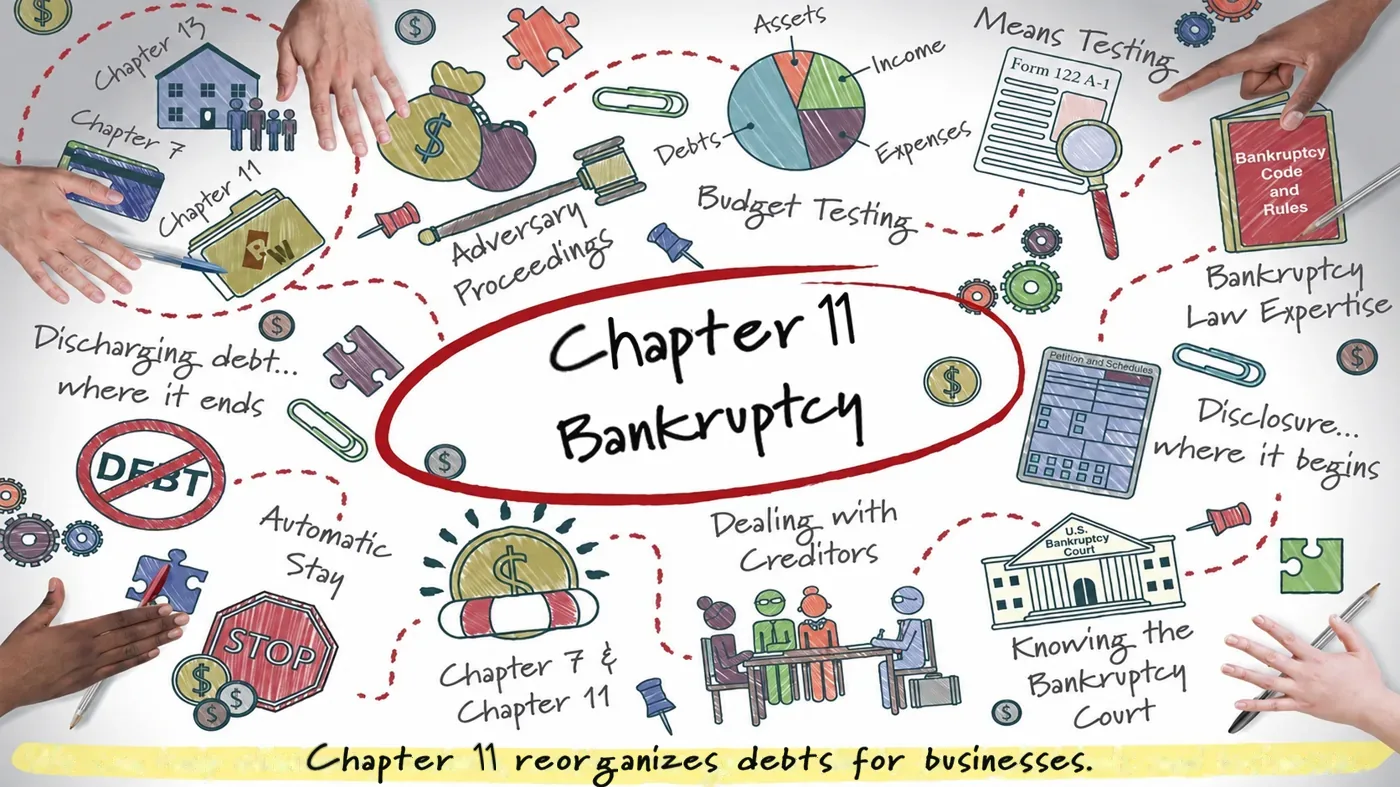
Chapter 11 reorganizes debts for businesses.

  • Serving Nassau County
  • Keep operating
  • Restructure debt
What a Chapter 11 Lawyer in Nassau County Does

A reorganization that keeps the doors open

A Chapter 11 bankruptcy lawyer in Nassau County files a reorganization case that lets a business, or a high-debt individual, restructure what is owed while continuing to operate, rather than shutting down and liquidating.

House illustration

The owner stays in charge as the debtor in possession, keeps running the company, and proposes a plan to repay or reduce debt over time under court supervision.

Pie graph illustration

It is the tool for a Nassau enterprise whose balance sheet is fixable but whose current payments are not, and for a filer whose debts run past the Chapter 13 limits. Since 1988 this firm has handled that work for Long Island businesses and their owners.

Business owners who reorganized their affairs through Chapter 11
Chapter 11 Reorganization

Chapter 11 lets a business keep running as a debtor in possession while it reorganizes under bankruptcy court and US Trustee supervision. Creditors vote on a plan, usually reduced payments over time, and the court must approve it.

Bankruptcy in General

Bankruptcy resolves debt without needing creditor approval. Chapter 7 eliminates debt, Chapter 13 reorganizes it for individuals and Chapter 11 for businesses, and each stops collection with the automatic stay and ends in a discharge.

The Automatic Stay

The automatic stay starts the second a bankruptcy is filed and stops collection calls, lawsuits, wage garnishments, bank restraints, car repossessions and foreclosures. A creditor who knowingly violates it can be sanctioned or made to pay damages.

Chapter 11 vs. Subchapter V

Regular Chapter 11 is slower and more detailed, with no strict plan length, a disclosure statement and a creditor vote. Subchapter V suits smaller businesses: faster and simpler, a five-year plan limit, and no disclosure statement or vote.

Section 01

When Chapter 11 fits your Nassau case

Chapter 11 is the reorganization tool for Nassau corporations, partnerships, and LLCs, and for individuals whose debts are too large for Chapter 13 or who need a longer repayment period than five years.

Entities
Businesses reorganize here
Corporations, LLCs, and partnerships cannot use Chapter 13, so a Nassau business reorganizes in Chapter 11.
Over the cap
Debts past the Chapter 13 limits
An individual whose debts exceed the Chapter 13 ceilings files Chapter 11 instead. Those limits are set by statute and adjust over time.
Keep property
Restructure, don’t liquidate
A Nassau homeowner, landlord, or high-net-worth filer keeps property and restructures debt on a court-approved plan.
5+ Yr
Longer repayment period
A Chapter 11 plan can extend repayment beyond the five (5) years available in a Chapter 13 plan.
Petition and schedules illustration

A Chapter 11 case can be filed by a corporation, partnership, or limited liability company, since those entities cannot reorganize in Chapter 13, which is only available for individuals. An individual, whether filing alone, as a married couple, or as a sole proprietor, can also file Chapter 11, and needs to when the debt runs past the ceilings that Chapter 13 allows. This is the general Chapter 11 bankruptcy process explained for every filer; this page is where it meets Nassau County.

Stop sign illustration

A Chapter 11 case is necessary when a Nassau business wants to keep operating despite creditor activity, such as bank restraints, repossessions, evictions, tax lien closures, and foreclosure sales, that would otherwise force it to close. If the business can reorganize its financial affairs, Chapter 11 lets a company with a good reputation and a viable product or service survive its hardships and potentially come out in a stronger position.

Bankruptcy code book illustration

Chapter 11 is also the path for individual filers whose debts exceed what Chapter 13 can hold, or who need longer than five (5) years to repay. A Nassau homeowner, landlord, or high-net-worth individual can sit above the Chapter 13 caps and still want to keep property rather than liquidate. If your situation is instead a straightforward consumer matter, a general bankruptcy lawyer in Nassau County on our team handles the Chapter 7 and Chapter 13 side. For most small businesses, the version that matters is Subchapter V, a streamlined small-business track covered in detail below.

Is creditor activity threatening your Nassau business?A Chapter 11 filing can protect it while you reorganize. Find out how in a free, confidential review.
Schedule a Free Consultation
Smiling family with their baby at home
You’re Not Alone

Thousands of families, one fresh start

Since 1988 we’ve guided New Yorkers out of debt and back to the lives they want to live.

Section 02

Filing the case and the “automatic stay”

The moment the Chapter 11 petition is filed, an automatic stay goes immediately into effect to protect the debtor’s assets. The case must start with a goal and an exit strategy in mind.

Means-test form illustration

Here is a fact the location-template pages never mention: no bankruptcy court sits inside Nassau County itself. Nassau reorganization cases are filed in and assigned to the U.S. Bankruptcy Court for the Eastern District of New York, Central Islip division, at 290 Federal Plaza, where the United States Trustee oversees the case and the 341 meeting of creditors is held. Starting the case sets in motion an involved matter requiring financial disclosure, court supervision, and Trustee and court input on major decisions, so a client needs a goal and an exit strategy from day one. The petition and schedules, filed to open the case, give notice to all parties in interest and disclose the debtor’s financial affairs.

House illustration

Upon the filing of the petition, an “automatic stay” goes immediately into effect to protect the debtor’s assets. A Chapter 11 case (unlike Chapter 13) allows a longer period to file the plan of reorganization and longer under a proposed plan to pay pre-petition debt and arrears. Even so, the Chapter 11 debtor must remain current, during and after the case, on post-petition payments for secured debt such as mortgages, vehicle payments, and equipment loans, and current on lease or rent obligations. A secured creditor not receiving regular post-petition payments, or a landlord not receiving rent, can move for relief from the stay, which in a Chapter 11 case is usually contested, with the debtor moving to quickly cure the post-petition arrears. Any related collection or lease lawsuit against the business runs on a separate state track in Nassau County District Court or Nassau County Supreme Court in Mineola.

The Automatic Stay

Instant protection the day you file

The moment the Chapter 11 case is filed, the automatic stay takes hold and creditor activity that would force the business to close must stop. Here is what that means.

Foreclosure sales & tax lien closures are stopped
Repossessions & evictions are halted
Bank restraints on the business stop
The business keeps operating while it reorganizes
Section 03

The debtor in possession and its duties

On filing, the entity becomes a “debtor in possession,” a fictional new entity allowed to operate its business under Bankruptcy Court supervision, subject to strict administrative duties.

Pie graph illustration

Upon the filing of the Chapter 11 petition, the filing entity becomes a “debtor in possession,” a fictional new entity allowed to keep operating its business under Bankruptcy Court supervision. That is the whole point of Chapter 11: the owner stays in charge and keeps running the company. The business’s principals, together with its Chapter 11 attorneys, must meet the administrative requirements throughout the case.

Petition and schedules illustration

Because those requirements are involved, a Nassau business is required to be represented by an attorney experienced in Chapter 11 cases, and usually retains its accountant as well. The requirements allow post-petition oversight and disclosure, so the Bankruptcy Court and the Office of the United States Trustee at Central Islip can monitor the progress of the reorganization and the likelihood that the debtor can offer a feasible plan.

What the Debtor Must Do

Ongoing duties of a debtor-in-possession

  • File monthly operating reports on the business’s finances.
  • Show up at creditor meetings and court status conferences.
  • File motions when seeking permission to act outside the ordinary course of business.
  • Run all finances through a Debtor-in-Possession bank account, including the escrow of taxes and regular deposits and payments of expenses.

The business is required to retain an attorney experienced in Chapter 11 cases and usually retains its accountant as well.

Family relaxing together in their living room
A Way Forward

Solutions built around your business

Every situation is different. We find the path that protects what matters most to you.

Free Consultation
Section 04

Reorganizing and negotiating with creditors

During the case, the debtor keeps up with post-petition obligations and negotiates with key creditors, and, for individual debtors, can pursue a mortgage modification through court-supervised Loss Mitigation.

Stop sign illustration

During the Chapter 11 case the Nassau client goes back to making post-petition mortgage payments each month and otherwise keeps up with ongoing post-petition obligations. The client is prohibited from curing pre-petition debts during the case until a plan of reorganization is approved. Certain creditors or creditor groups are important in a case, and the debtor may have to negotiate and reach an accommodation with them in order to successfully reorganize.

Secured Creditors & Cash Collateral

Creditors with an interest in cash collateral, rents, inventory, or other assets must be given “adequate protection” under a cash collateral agreement, so the debtor is permitted to use those assets.

Mortgage Holders

Mortgage holders need to receive monthly post-petition mortgage payments throughout the case.

Landlords & Lessors

Landlords and equipment lessors need to receive post-petition monthly payments to keep those leases in place.

Unsecured Creditors

Unsecured creditors may be represented by an official committee of unsecured creditors, if there are enough interested unsecured creditors.

Bankruptcy code book illustration

Leases and executory contracts can be assumed or rejected in a Chapter 11 case, letting the debtor “cherry-pick” among its agreements, keeping the ones that work and rejecting the ones that are not economically viable. Deadlines govern the time to assume or reject certain leases, the exclusivity period for offering a plan, and the time by which the plan must be filed and approved. If the debtor meets the administrative requirements and the case appears economically viable, the court will next require a plan of reorganization. But if the debtor cannot meet those requirements, or the case appears not to be viable, the court can dismiss the case, causing the debtor to lose bankruptcy court protection, or convert it to a Chapter 7 liquidation, where the business is closed and its assets sold to satisfy creditors.

Loss Mitigation in a Chapter 11 Case

Mortgage modification, court-supervised

For an individual debtor, the debt that requires reorganization in Chapter 11 is often a mortgage in arrears, which is common among Nassau homeowners with high-value properties. One way to deal with arrears is a plan where the debtor “catches up” or cures them under a traditional Chapter 11 plan, typically over five (5) to eight (8) years. Now that many foreclosures rest on years of arrears, a “catch-up” plan does not always work, since paying both the post-petition monthly mortgage directly to the lender and a separate catch-up payment can be too expensive, especially with the larger mortgages generally seen in individual Chapter 11 cases. Seeking a mortgage loan modification through the Loss Mitigation program adopted by the Bankruptcy Court has therefore become a standard way to proceed. Loss Mitigation is the debtor’s pursuit of a modification, overseen and encouraged by the court, which can press both the debtor’s and lender’s attorneys to coordinate over documents and information to determine whether the debtor qualifies.

The Sequence for Loss Mitigation

Motion → conferences → adequate protection

In the initial part of the case, the debtor makes a motion to the Bankruptcy Court for Loss Mitigation, trying to show it has the financial ability to sustain a potential modification of the defaulted mortgage loan. The lender’s attorneys have the right to oppose that motion. Assuming it is granted, the debtor and the lender’s attorneys must attend regular Loss Mitigation conferences to determine whether the effort to obtain a modification is still viable. During this time, the Chapter 11 debtor pays a hypothetical “adequate protection” payment to the lender, usually similar to the former mortgage payment, to demonstrate an ability to pay the estimated amount if the modification were approved, and to keep the lender’s secured position from deteriorating while the reorganization continues.

The Mechanics of Loss Mitigation

Trial modification → permanent agreement

If the Loss Mitigation efforts remain viable, the Court keeps adjourning the conferences. If they appear to be failing, and reapplication or appeal options are not realistic, the Court ends Loss Mitigation and eventually asks the Trustee to move for dismissal. On the other hand, if the effort produces a trial modification the debtor accepts and pays regularly, from three (3) months to a year, the lender will eventually offer a permanent modification agreement, subject to Bankruptcy Court approval after a motion. Once approved, the modification may be part of an overall Chapter 11 plan under which the debtor reorganizes all of its debts. Although a confirmed plan generally runs five (5) to eight (8) years, and modifications usually run thirty (30) to forty (40) years, most of the modification continues past the end of the Chapter 11 plan. If the defaulted mortgage was the only debt to address, the debtor can voluntarily dismiss the case once the permanent modification is obtained and approved.

Need to reorganize business debt, or a large mortgage in arrears?We will map a realistic reorganization and exit strategy for your Nassau case, free.
Get a Free Case Review
Serving Nassau County and Long Island
Local Counsel Since 1988

Trusted Chapter 11 reorganization representation for Nassau County and across Long Island.

Schedule a Free Consultation
Excellent ★★★★★ 4.9 | Verified Google reviews
Section 05

The Chapter 11 plan of reorganization

The debtor must offer a plan of reorganization and a disclosure statement within a set time. The plan divides creditors into “classes” that vote, and can even “cram down” a rejecting class.

Means-test form illustration

The Chapter 11 debtor must offer a plan of reorganization and a disclosure statement within a certain amount of time as dictated by law and by the bankruptcy court. The Chapter 11 plan is a potentially complex plan that divides the debtor’s creditors into groups of “classes” that vote on the plan. The amounts due to creditors are either scheduled by the debtor or asserted by creditors in proofs of claim filed prior to a proof-of-claim bar date set by the court. To the extent the debtor disagrees with a filed proof of claim, it can move by motion to object to the claim.

House illustration

In a small-business Chapter 11, the plan is usually proposed and potentially approved within a year, and typically proposes to pay creditors over a period that varies between cases but is often five (5) to eight (8) years. Under the plan, secured debt arrears and priority tax arrears must be cured in full over the repayment period, while unsecured debts are often paid at a small pro-rata percentage. By giving the debtor time to propose the plan and time to make payments, which may be at a reduced rate, the plan can allow the “breathing spell” necessary to reorganize. To confirm a plan, the debtor needs its creditors to vote for it by certain margins in each class, those holding at least two-thirds in amount and more than one-half in number. Alternatively, the debtor can “cram down” a rejecting class if a class below it votes in favor of the plan.

The disclosure statement.

Accompanying the proposed plan is a disclosure statement, under which the debtor must give creditors the information they need to decide how to vote, including financial information and projections that explain what the debtor anticipates if it reorganizes, and a liquidation analysis that explains the alternatives if it liquidates. Usually the disclosure statement must be approved by the court and the plan approved by a vote of the creditors. If the plan is approved, the debtor must begin to pay its pre-petition creditors as agreed. If the plan is not approved, the debtor can amend it and offer it again for a vote, but if it cannot confirm a plan, or the case is not economically feasible, the court can dismiss the case or convert it into a Chapter 7 case.

A family whose finances were reorganized through Chapter 11
The Weiss Difference

Your Nassau business protected, your debts reorganized, and your footing restored.

Schedule a Free Consultation
Happy family with young children at home
Real Relief

A fresh start for your whole business

The right filing can eliminate or reduce overwhelming debt, giving your business room to breathe, stabilize, and move forward with confidence.

Section 06

Motions to dismiss, convert & for relief from the stay

Where a case is delayed, adrift, and appears to lack feasibility, the United States Trustee at Central Islip or the debtor’s creditors can make motions that end the reorganization or lift the automatic stay.

Motions to Dismiss and/or Convert the Case

Usually by the U.S. Trustee

Motions to dismiss the Chapter 11 case, or to convert it to Chapter 7, can be made by the United States Trustee overseeing a case that is drifting where the reorganization seems delayed or problematic, and less often by a creditor or the Court on its own. Such a motion is not unusual in the early pre-confirmation part of a case, based on any administrative, procedural, financial, or documentary deficiency. Reasons include: arrears on vital payments, such as post-petition taxes, secured-creditor adequate-protection payments, and basic operational expenses; lack of feasibility given the proofs of claim filed; noncompliance with the financial documents the Trustee requests; problems or delays with the schedules, plan, or credit-counseling certificate; non-attendance at critical hearing dates, such as the creditors’ meeting; and unreasonable delay or impossibility in getting a modified loan in a loss-mitigation case. Essentially any problem in the early part of a case gives reason for such a motion. Once the plan is confirmed, there are fewer reasons, except for arrears on plan payments and other critical payment matters.

Dismissal vs. Conversion

The choice is made by the Court

If a motion to dismiss is granted, the case is over, and to overcome that order one would need to vacate the dismissal or start a new Chapter 11 case where possible. If a motion to convert is granted, the case continues as a Chapter 7, where a Chapter 7 trustee is appointed to liquidate and marshal assets for creditors. Debtors having difficulty reorganizing usually prefer a case dismissed rather than converted, but the choice of what to do with an unsuccessful reorganization is made by the Court. If a debtor can show there is no advantage to creditors in conversion after the failed effort, the case is dismissed rather than converted.

Motions for Relief from the Stay

By secured & contested creditors

Motions for relief from the automatic stay (to lift, modify, or vacate it) are made by secured creditors where the debtor has fallen into arrears on post-petition mortgage or other post-petition secured payments, which are often treated as “adequate protection” for their positions. Any secured creditor expecting a regular monthly post-petition mortgage, HELOC, vehicle, tax, or other secured payment can move for relief if payments are not made on time. Other creditors who can be granted relief are contested creditors in litigation with the debtor over liability or damages, in tort, matrimonial or family, surrogate’s, and other matters not involving obligations created by credit and lending. Once relief is granted, the creditor can pursue the litigated matter as if there were no pending bankruptcy case.

Section 07

Subchapter V and the three tracks of Chapter 11

There are three ways to reorganize under Chapter 11: Standard Chapter 11, Small Business Chapter 11, and Subchapter V, the streamlined small-business path, each with different eligibility, deadlines, and strategy.

 
Standard-11
SB-11
Subchapter V
Created by
Standard-111978 Bankruptcy Reform Act
SB-112005 Bankruptcy Abuse Act
Subchapter V2019 SBRA, expanded 2020
Debt limit
Standard-11None
SB-11Statutory ceiling
Subchapter VStatutory ceiling set by law, adjusts over time
Time to file a plan
Standard-11By court order
SB-11300 days
Subchapter V90 days
Disclosure statement
Standard-11Required
SB-11Required
Subchapter VNot required
Type of trustee
Standard-11U.S. Trustee
SB-11U.S. Trustee
Subchapter VPrivate businessperson
Deadlines
Standard-11Longest, least strict
SB-11Short & draconian
Subchapter VShort but forgiving
Pie graph illustration

For most Nassau small businesses, the version of Chapter 11 that matters is Subchapter V, a streamlined small-business track added to speed the case up and strip out the cost that made traditional Chapter 11 impractical for a corner practice or a family firm. It usually runs without a creditors’ committee, moves on a compressed timeline, and keeps the owner in control while a trustee facilitates rather than takes over. The debt ceiling that decides eligibility is set by statute and adjusts periodically, so we confirm your current numbers against the live limit rather than quote a figure that goes stale. For the medical practices, retail storefronts, contractors, and landlords along Nassau’s dense commercial corridors, it is often the difference between reorganizing and closing. In order from the most complex and least rigid to the most efficient and tightest: a) Standard Chapter 11 (“Standard-11”) with the longest, least strict deadlines; b) Small Business Chapter 11 (“SB-11”) with short and strict deadlines; and c) Subchapter V (“V-11”) with shorter deadlines than SB-11 but less strict.

Eligibility & the Type of Trustee

Who qualifies, and who oversees

V-11 and SB-11 both require the debtor’s debt to fall under a statutory ceiling that is set by law and adjusts over time, so we confirm eligibility against the current limit rather than a fixed figure; Standard-11 has no debt limit. SB-11 and V-11 also require that at least half the debt arise mostly from the business or commercial activity of the debtor, except a single-asset real estate debtor does not qualify under either. Under Standard-11 and SB-11, the United States Trustee’s office oversees the case, involving its attorneys and financial analysts with an emphasis on the legal and administrative requirements. V-11 allows a radical change: the trustee is not an attorney and not from the U.S. Trustee’s office, but a private businessperson who oversees the case from a business perspective, which is advantageous for debtors and their attorneys who sometimes find the U.S. Trustee more focused on administrative niceties that conflict with the economic realities of reorganizing.

Deadlines, Exclusivity & Plan Requirements

Why SB-11 is draconian

SB-11 has a deadline of 300 days to file a plan and disclosure statement; V-11 has 90 days to file a shorter plan with no disclosure statement; Standard-11 has no statutory deadline, with the date set by court order. Under SB-11, the debtor has exclusivity for 120 days but loses it if it fails to confirm within 180 days; under V-11 the debtor never loses exclusivity; Standard-11 has the same 120/180-day periods as SB-11, but extensions are granted under a less strict standard (subject to an 18-month cap to file and 20 months to confirm). For SB-11, the deadline to confirm is 45 days after the plan is filed, which is extremely difficult, since it needs a motion showing cause and a written order entered within that 45-day period, where any mishap in timing can be devastating. V-11 and Standard-11 have no such statutory confirmation deadline.

Strategy: Go With V-11 or Standard-11, Not SB-11

Choose the debtor-friendly scheme

The goals of the statutes that created each scheme are very different. The 1978 Bankruptcy Reform Act (Standard-11) and the 2019 SBRA plus 2020 CARES Act (V-11) were sympathetic to debtors, producing schemes that are workable and forgiving. The 2005 Bankruptcy Abuse Act (SB-11), by contrast, was meant to curb debtor abuse, is more sympathetic to creditors, and is draconian if a deadline to extend the time to confirm the plan is not timely entered. The strategy follows: if a small business meets the debt level and other requirements of V-11, file under V-11 and avoid SB-11. If V-11 is unavailable, file under Standard-11 and again avoid SB-11, which is mostly disadvantageous compared to both.

COVID-19 and the CARES Act: Subchapter V expanded.

The Coronavirus Aid, Relief and Economic Security (“CARES”) Act, signed into law March 27, 2020, made substantive changes to the Bankruptcy Code, most notably a temporary expansion of Subchapter V (already part of the Small Business Reorganization Act of 2019) by raising its debt ceiling for a limited period, an increase that has since expired. The most innovative change was having a businessperson, rather than an attorney from the U.S. Trustee’s office, serve as trustee, shifting the focus toward the business’s financial health. Subchapter V also streamlined plan approval by dispensing with the disclosure-statement requirement and allowing a shorter, less complex plan.

A couple back on their feet after a Chapter 11 reorganization
Life After Chapter 11

Room to breathe again, your Nassau business reorganized and your debts back under control.

Talk to an Attorney
Family together by a bright window at home
A fresh start you can build a life on. Thousands of New York families have already turned the page.
Section 08

The “exit strategy” and the bankruptcy “final decree”

Chapter 11 protection is inherently temporary, with most cases lasting six months to two years, so the debtor is under pressure from the start to lay out a feasible road map to turn the business around.

Petition and schedules illustration

Many Chapter 11 cases are filed on an emergency basis and as a last resort for a Nassau debtor needing protection from creditors. Often, just before filing, the debtor does not yet have an immediate solution and is hoping to find one during the reorganization. Chapter 11 gives immediate protection, but that protection is temporary, since most cases last six months to two years, and there is pressure from the start to lay out and take steps toward an “exit strategy,” a general road map to improve, repair, and turn around the business. The faster a debtor can show the trustee and creditors a feasible exit strategy, the more time and leeway it is given. Methods of reorganization can include:

Methods of Reorganization

How a debtor implements an exit strategy

  • A sale of assets, like real estate, to raise cash to pay the creditors.
  • A rejection of leases or contracts, such as employment, consulting, or service agreements, to cut expenses.
  • An increase in income and/or a reduction in expenses to improve the budget, so as to be able to reorganize.
  • A mortgage modification and/or settlements or payment plans with other creditors.
  • Financing during the case to bring in enough cash to take out the debt and pay a refinanced amount over a long-term loan on better terms.

If the case drifts and the debtor lacks direction and hope of a reorganization, the trustee will move to convert or dismiss and creditors will move to lift the stay, so the debtor must be forthcoming with a feasible exit strategy and work to implement it.

Stop sign illustration

Concluding the case and the “final decree.” After the Chapter 11 plan is confirmed, the debtor needs to initiate its payments to creditors under the plan. Assuming the debtor has been making the initial payments for several months, it applies to the court for a “final decree” by demonstrating that it has successfully begun to implement the plan. Upon issuance of the final decree, the court closes the Chapter 11 case but keeps jurisdiction over the plan, if disputes arise as to its terms or as to whether the debtor is making its payments. The debtor’s protection from its creditors continues while it is making payments under the plan, but if the debtor defaults, creditors have the right to relief by showing non-payment to the court. Assuming the debtor is still a viable business, Chapter 11 cases are often highly effective in giving the business an opportunity to reorganize and reduce debt over a protracted time while being protected from its creditors.

Have an exit strategy in mind, or need help building one?We will review the reorganization options that fit your business or personal circumstances, free.
Schedule a Free Consultation
Section 09

Why file Chapter 11 with our Nassau County firm

A Chapter 11 is not a form you file and forget. It is a plan you draft, negotiate with creditors, and confirm in court, which is litigation and negotiation work a settlement company simply cannot do.

Bankruptcy code book illustration

Our Nassau anchor is the Mineola office at 34 Willis Ave, minutes from the county courts, reachable at 516-307-0262. We file Chapter 11 and Subchapter V cases before the United States Bankruptcy Court for the Eastern District of New York at Central Islip, the division that hears Nassau reorganization cases, and handle the filing and amending of the numerous documents and the plan needed to proceed. You deal one-on-one with an attorney on a fee agreed in writing, and the firm carries the case from the first-day filing through plan confirmation without ever handing you to a rotating case manager.

Means-test form illustration

The verifiable marks: an Avvo rating of 10.0 “Superb” and a 4.9 aggregate, a Martindale-Hubbell 5.0, a BBB A+ rating, and 2026 Super Lawyers selection. Ron clerked for a U.S. Bankruptcy Judge and published bankruptcy scholarship at NYU, authority a directory listing or a one-page competitor with no reviews cannot match. When a reorganization stretches across the Island, a Long Island bankruptcy lawyer on the same team runs it through Nassau and Suffolk without a handoff.

Law Offices of Ronald D. Weiss, P.C., serving Nassau County from Mineola and Long Island
Protect the business from creditorsThe automatic stay halts creditor activity the day you file.
Reorganize over a planCure, extend, and reduce obligations over a 5-to-8-year plan of reorganization.
Keep operating & emerge strongerA viable business can survive its hardships and come out in a stronger position.
Experienced court representationRegular practice in the Eastern & Southern Districts of New York.

Our consultations are free, and the advice may be invaluable.

Not Sure How to Deal With Your Debt?

Free Consultation Available Now

In a free consultation, we go through your situation and your options with you, and decide on a plan of action.

Creative Legal Solutions to Your Debt Challenges video

Creative Legal Solutions to Your Debt Challenges. See how we deliberate with you and strategize which options best apply to your situation, and how to best resolve your debt challenges.

Free & Confidential

Let’s see whether your business can reorganize

Ronald D. Weiss has represented Long Island businesses and individuals since 1988. Free consultation, available 24/7 at 888-4-U-NEW-START, or reach the Mineola office at 516-307-0262.

The Ronald D. Weiss legal team
↑ Top