(631)-271-3737,
QUEENS
(718)-751-0226
(516)-307-0262,
BROOKLYN
(347)-508-9316,
BOHEMIA
(631)-223-4502
(631)-271-3737,
QUEENS
(718)-751-0226
(516)-307-0262,
BROOKLYN
(347)-508-9316,
BOHEMIA
(631)-223-4502
Keep the Suffolk business open while you reorganize: restructure the debt, stay in control as debtor-in-possession, and keep operating, with a Long Island attorney who files business cases at Central Islip inside Suffolk.


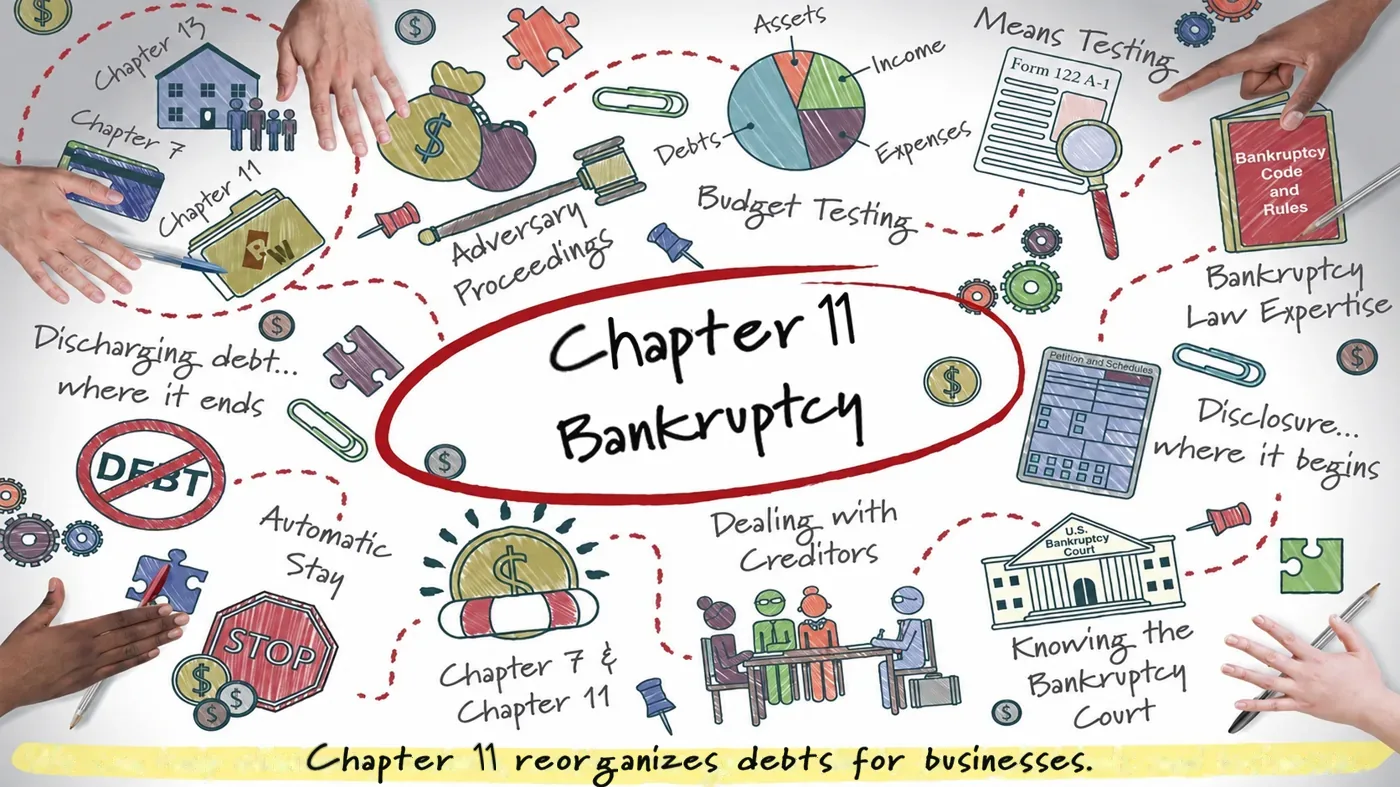
Chapter 11 reorganizes debts for businesses.
A Chapter 11 bankruptcy lawyer in Suffolk County reorganizes a struggling business instead of shutting it down: you keep operating, keep the payroll running, and stay in charge of the company as debtor-in-possession.

A court-approved plan restructures what you owe over time. It works for a Suffolk company, from a Riverhead contractor to a Hamptons restaurant to a Smithtown medical practice, and for individuals whose debts are too large for Chapter 13.

Since 1988 this firm has filed these cases at the U.S. Bankruptcy Court for the Eastern District of New York, Central Islip division, which sits inside Suffolk, so the business owner is not driving to Brooklyn to save the company.

Chapter 11 lets a business keep running as a debtor in possession while it reorganizes under bankruptcy court and US Trustee supervision. Creditors vote on a plan, usually reduced payments over time, and the court must approve it.
Bankruptcy resolves debt without needing creditor approval. Chapter 7 eliminates debt, Chapter 13 reorganizes it for individuals and Chapter 11 for businesses, and each stops collection with the automatic stay and ends in a discharge.
The automatic stay starts the second a bankruptcy is filed and stops collection calls, lawsuits, wage garnishments, bank restraints, car repossessions and foreclosures. A creditor who knowingly violates it can be sanctioned or made to pay damages.
Regular Chapter 11 is slower and more detailed, with no strict plan length, a disclosure statement and a creditor vote. Subchapter V suits smaller businesses: faster and simpler, a five-year plan limit, and no disclosure statement or vote.
In a Chapter 11 the business keeps its doors open. The day the petition is filed the automatic stay freezes collection, and you keep trading as debtor-in-possession while a plan restructures what you owe.

In a Chapter 11 bankruptcy the business keeps its doors open. The day the petition is filed the automatic stay freezes collection, lawsuits, and lockout or seizure attempts, and you continue trading as debtor-in-possession, meaning no trustee takes the wheel and you keep signing the checks.

From there the case builds a plan of reorganization: secured loans and equipment financing can be stretched or reset, unsecured debt is often paid back at a fraction over the plan term, and a lease or contract that is sinking the business can be renegotiated or shed. Major moves such as selling an asset or taking on new financing need court approval, which is the trade for staying in control.

Suffolk is where this fits a real pattern: seasonal East End and hospitality revenue that swings hard between summer and winter, high commercial rents, and trades and construction firms with heavy equipment debt. A reorganization sized to a cash flow that peaks in July is a very different plan from a steady inner-suburb storefront, and that is the plan we build.

Since 1988 we’ve helped Suffolk County owners reorganize the company and keep it running.
The moment the Chapter 11 petition is filed, an automatic stay goes immediately into effect to protect the Suffolk business, but the owner must have a goal and an exit strategy from the very start.

Starting a Chapter 11 case sets in motion a potentially involved matter requiring financial disclosure, court supervision, and trustee and court input as to important decisions for the business. A Suffolk owner needs a goal and an exit strategy from the moment they file. The company’s budget has to be reviewed carefully to set realistic expectations for reorganizing the debt. The bankruptcy petition and schedules, filed to start the case, give notice to all parties in interest and disclose the debtor’s financial affairs.

Upon the filing of the petition, an “automatic stay” goes immediately into effect to protect the business. Chapter 11 allows a longer period than Chapter 13 for the debtor to file its plan of reorganization, and longer under a proposed plan to pay pre-petition debt and arrears. Even so, the debtor must remain current with post-petition payments for secured debt, such as mortgages, vehicle payments, and equipment loans, and current under lease or rent obligations. A secured creditor not getting regular post-petition payments, or a landlord not receiving rent, can move for relief from the stay, which in a Chapter 11 case is usually contested, with the debtor seeking to quickly cure the post-petition arrears.
The moment the Chapter 11 case is filed, the automatic stay takes hold and creditor activity that would force the business to close must stop. Here is what that means.
On filing, the business becomes a “debtor-in-possession”: the same owner keeps operating the company under Bankruptcy Court supervision, in exchange for meeting a set of administrative duties.

Upon filing the petition, the business becomes a “debtor-in-possession”, allowed to keep operating under Bankruptcy Court supervision with the owner still at the helm. The company’s principals, together with their Chapter 11 attorneys, must meet the administrative requirements of the case.

Because those requirements can be involved, a Suffolk business is required to be represented by an attorney experienced in Chapter 11 cases, and usually retains its accountant as well. The requirements allow post-petition oversight and disclosure, so the Bankruptcy Court and the Office of the U.S. Trustee can monitor the reorganization and the likelihood of a feasible plan.
The business is required to retain an attorney experienced in Chapter 11 cases and usually retains its accountant as well.

Every company is different. We find the path that keeps the Suffolk business operating and in your hands.
Free ConsultationDuring the case, the Suffolk business keeps up with post-petition obligations and negotiates with key creditors, and an individual debtor can pursue a mortgage modification through court-supervised Loss Mitigation.

During the Chapter 11 case the business goes back, on a monthly basis, to making post-petition payments and otherwise keeps up with its ongoing post-petition obligations. It is prohibited from curing pre-petition debts during the case until a plan of reorganization is approved. Certain creditors or creditor groups are important to a case, and the debtor may have to negotiate and reach an accommodation with them to reorganize successfully.
Creditors with an interest in cash collateral, rents, inventory, or other assets must be given “adequate protection” under a cash collateral agreement, so the debtor is permitted to use those assets.
Mortgage holders need to receive monthly post-petition mortgage payments throughout the case.
Landlords and equipment lessors need to receive post-petition monthly payments to keep those leases in place.
Unsecured creditors may be represented by an official committee of unsecured creditors, if there are enough interested unsecured creditors.

Leases and executory contracts can be assumed or rejected in a Chapter 11 case, allowing the debtor to “cherry-pick” among its agreements, keeping the ones that work and rejecting the ones that are not economically viable. There are deadlines governing the time the debtor has to assume or reject certain leases, the time for the debtor to have exclusivity in offering a reorganization plan, and the time by which the plan must be filed and approved. If the debtor meets the administrative requirements and the case appears economically viable, the court will next require the debtor to offer a plan of reorganization. But if the debtor has trouble meeting those requirements, or the case appears not to be economically viable, the court could dismiss the case, causing the debtor to lose bankruptcy court protection, or convert the case to a Chapter 7 liquidation, where the business is closed and its assets sold to satisfy creditors.
In the case of an individual debtor, often the debt that requires reorganization in Chapter 11 is a mortgage that is in arrears. One way of dealing with mortgage arrears is a plan where the debtor will “catch up” or cure the arrears under a traditional Chapter 11 plan, typically over five (5) to eight (8) years. However, now that many foreclosures are based on arrears of many years, a “catch-up” plan would not always work, since it may be too expensive to pay both the post-petition monthly mortgage payment directly to the lender and a separate “catch-up” payment, especially where mortgages are for higher amounts, as is generally true in Chapter 11 cases filed by individual debtors. Therefore, seeking a mortgage loan modification through Loss Mitigation programs adopted by most Bankruptcy Courts has become a standard way to proceed. Loss Mitigation is the pursuit of a mortgage modification by the debtor, overseen and encouraged by the Bankruptcy Court, which can pressure both the debtor’s and lender’s attorneys to coordinate over documents and information to determine whether the debtor qualifies for a modification.
In the initial part of the case, the debtor makes a motion to the Bankruptcy Court for Loss Mitigation, trying to show it has the financial ability to sustain a potential modification of the defaulted mortgage loan. The lender’s attorneys have the right to oppose that motion. Assuming the motion is granted, the debtor and the lender’s attorneys are required to attend regular Loss Mitigation conferences to determine whether the effort to obtain a modification is still viable. During this time, the Chapter 11 debtor pays a hypothetical “adequate protection” payment to the lender, usually similar to the former mortgage payment, to demonstrate an ability to pay the estimated amount if the modification were approved, and to prevent the lender’s secured position from deteriorating while the potentially long reorganization continues.
If the Loss Mitigation efforts remain viable, the Court keeps adjourning the conferences. If they look like they are failing, and reapplication or appeal options are not realistic, the Court will end Loss Mitigation and eventually ask the Trustee to move for dismissal. On the other hand, if the effort results in a trial modification the debtor accepts and pays regularly, from three (3) months to a year, the lender will eventually offer a permanent modification agreement, subject to Bankruptcy Court approval after a motion. Once approved, the loan modification may be part of an overall Chapter 11 Plan under which the debtor reorganizes all of its debts. Although a confirmed plan generally lasts an average of five (5) to eight (8) years, and modifications usually run thirty (30) to forty (40) years, the majority of the modification would continue past the end of the Chapter 11 plan. Alternatively, if the defaulted mortgage was the only debt to address, the debtor can voluntarily dismiss the case once the permanent modification is obtained and approved.

Business reorganization representation across Suffolk County, filed at Central Islip inside the county.
Get My Free ConsultationCost and timeline are the two questions the search results answer thinly, so here is the straight version for a Suffolk County business weighing whether to reorganize.

A traditional Chapter 11 is the more expensive process because of its committees, reporting, and length, and it typically runs a year or more from filing to a confirmed plan. Subchapter V was designed to cut both: it moves faster and costs meaningfully less, with the plan due within months of filing rather than open-ended, which is why it is the realistic route for most Suffolk small businesses.

Either way the business keeps operating and earning throughout, and much of the professional cost is structured through the case rather than paid all at once up front. That is part of what makes reorganizing survivable: the company funds the process out of ongoing operations while it is protected, instead of finding a lump sum before it can act.
We quote a Suffolk business a scope and a fee in writing after we see the debt and the books, never a guess up front. The first consultation, the one that tells you whether you should file at all, is free. If a smaller matter belongs in Chapter 13, or the business does not need to file, we say so, because the point is to fix the problem at the lowest cost that actually solves it, not to sell the biggest case.
Your Suffolk business protected, your debt reorganized, and your footing restored.
Get My Free Consultation
The right filing can restructure overwhelming debt, giving a Suffolk company room to operate, recover, and move forward with confidence.
Here is the local fact the out-of-area firms and programmatic templates cannot honestly claim: a Suffolk County business Chapter 11 or Subchapter V is filed at Central Islip, inside the county where the business operates.
A Suffolk County business Chapter 11 or Subchapter V is filed in the U.S. Bankruptcy Court for the Eastern District of New York, Central Islip division, at the Alfonse M. D’Amato Federal Courthouse, 290 Federal Plaza. Central Islip is in Suffolk, so the courthouse, the assigned judge, the Subchapter V trustee, and the status conferences are all in the county where the business operates. That is not a marketing line. It is where the case physically lives.
An owner keeping a company alive cannot spend days commuting to another borough for hearings. Because the Central Islip courthouse sits inside Suffolk, that time stays in the business. We file there, appear there, and know how the Central Islip judges and trustees run these cases. From our Melville and Bohemia offices, minutes from the courthouse, the reorganization is handled close to where the company actually operates.
Separately, a business debt lawsuit or a foreclosure on commercial property runs through the Suffolk County courts, not the bankruptcy court, and we coordinate the reorganization with whatever is already moving against the company. When a creditor is already suing or foreclosing, the timing of the Chapter 11 filing and the automatic stay has to be sequenced against those state-court deadlines, which is exactly the kind of local coordination an out-of-area filing mill cannot manage.
There are three ways to reorganize under Chapter 11: Standard Chapter 11, Small Business Chapter 11, and Subchapter V. For most Suffolk small businesses the real choice is Standard-11 versus the streamlined Subchapter V.

Subchapter V is a streamlined version of Chapter 11 that Congress created specifically for small businesses, and for most Suffolk companies it is the path that actually makes reorganization affordable. It is faster and cheaper than a traditional Chapter 11: there is usually no separate committee of creditors, the process is compressed, and the owner ordinarily keeps the business rather than handing equity to creditors. Eligibility turns on the size and nature of the debt: the business has to be actively operating, and at least roughly half of what it owes needs to come from business activity rather than personal spending. There is a dollar ceiling on total debt, and because that limit is periodically adjusted we run the current figure against your actual numbers at the consultation instead of quoting a stale one here. For a Suffolk contractor, restaurant, retailer, or professional practice that qualifies, Subchapter V is often the difference between reorganizing and closing.
Standard Chapter 11 is the right tool when the debt is large, the ownership structure is complex, or an investor group and multiple lenders have to be brought to the table. It carries more process and cost, but it handles size, and it has no debt ceiling. Under Standard-11 the U.S. Trustee’s office oversees the case, involving its attorneys and financial analysts with an emphasis on legal and administrative requirements. For a larger Suffolk enterprise, or one with a tangled capital structure, that heavier process is what the situation actually calls for.
Subchapter V is the right tool for the typical Suffolk small business that is actively operating and under the debt ceiling, because it strips out the most expensive parts of the process and lets the owner keep the company. It moves on a compressed schedule, usually with no separate creditors’ committee and no disclosure statement, and its trustee is a private businessperson who oversees the case from the business perspective rather than an attorney from the U.S. Trustee’s office. For a contractor, restaurant, retailer, or professional practice that qualifies, it is the affordable road to reorganizing.
The question a Suffolk owner actually needs answered is which version to file, and no directory listing will tell you. There is also the honest third answer, that a smaller matter belongs in Chapter 13 or that the business does not need to file at all, and we say so when that is true. We run your debt totals, your revenue, and the source of the debt before recommending a path, so the choice is made on your numbers and not on which case pays us more.
Subchapter V, part of the Small Business Reorganization Act of 2019, was built to make reorganization workable for smaller companies. Its most important change was having a businessperson, rather than an attorney from the U.S. Trustee’s office, serve as trustee, shifting the focus toward the business’s financial health. It also streamlined plan approval by dispensing with the disclosure-statement requirement and allowing a shorter, less complex plan. The total-debt ceiling that governs eligibility is periodically adjusted, so we check the current number against your books at the consultation rather than rely on a figure that may already be out of date.
Room to operate again: your Suffolk business reorganized, your debt back under control.
Talk to an Attorney
Chapter 11 protection is inherently temporary, so a Suffolk business is under pressure from the start to lay out a feasible road map to turn the company around and emerge from the case.

Many Chapter 11 cases are filed on an emergency basis, as a last resort for a business needing protection from creditors. Often, just before filing, the owner does not yet have an immediate solution and is hoping to find one during the reorganization. Chapter 11 gives that immediate protection, but the protection is temporary, and there is pressure from the start to lay out and take steps toward an “exit strategy,” a general road map to improve, repair, and turn around the business. The faster a debtor can show the trustee and creditors a feasible exit strategy, the more time and leeway it is given. Methods of reorganization can include:
If the case drifts and the debtor lacks direction and hope of a reorganization, the trustee will move to convert or dismiss and creditors will move to lift the stay, so the debtor must be forthcoming with a feasible exit strategy and try to implement it.

Concluding the case and the “final decree.” After the Chapter 11 plan is confirmed, the debtor needs to initiate its payments to creditors under the plan. Assuming the debtor has been making the initial payments for several months, it applies to the court for a “final decree” by demonstrating that it has successfully begun to implement the plan. Upon issuance of the final decree, the court closes the Chapter 11 case but keeps jurisdiction over the plan, if disputes arise as to its terms or as to whether the debtor is making its payments. The debtor’s protection from its creditors continues while it is making payments under the plan, but if the debtor defaults, creditors have the right to relief by showing non-payment to the court. Assuming the debtor is still a viable business, Chapter 11 cases are often highly effective in giving the business an opportunity to reorganize and reduce debt over a protracted time while being protected from its creditors.
The pages competing for this search are mostly directories, a firm from out of state selling one product, and location templates with no real Suffolk content. This is a full law firm that reorganizes businesses.

This is a full law firm that reorganizes businesses and litigates when a creditor fights, with local anchors in Melville at 445 Broadhollow Road and Bohemia at 80 Orville Drive, minutes from the Central Islip courthouse. You deal with the attorney running the case, not a call center or a referral desk, on a scope and fee set out in writing, and the work stays in this firm rather than getting farmed out. When a matter is larger than one county or crosses into consumer debt, a Long Island bankruptcy lawyer on the same team carries it, and an owner who is not sure Chapter 11 is even the answer can start with a bankruptcy lawyer in Suffolk County on that team who will point to the cheaper fix when one exists.

The credentials behind that are verifiable, not a widget: an Avvo 10.0 “Superb” rating and a 4.9 aggregate, a Martindale-Hubbell 5.0, a BBB A+, and a 2026 Super Lawyers selection, with a founder who clerked for a U.S. Bankruptcy Judge and published bankruptcy scholarship at NYU Law. Since 1988 this firm has done this work on Long Island, which is authority a national directory listing simply does not carry.

Our consultations are free, and the advice may be invaluable.
Not Sure How to Deal With Your Debt?
Free Consultation Available Now
In a free consultation, we go through your situation and your options with you, and decide on a plan of action.

Creative Legal Solutions to Your Debt Challenges. See how we deliberate with you and strategize which options best apply to your situation, and how to best resolve your debt challenges.
How our attorneys can help at every stage of your case.
Free consultation. Available 24/7 at 888-4-U-NEW-START, or reach the Melville office at 631-212-1046. We’ll tell you whether to file, and which path fits your numbers, before you owe us anything.